


.webp)
If your furniture design data stops at the SKU level, your Digital Product Passport is already obsolete.
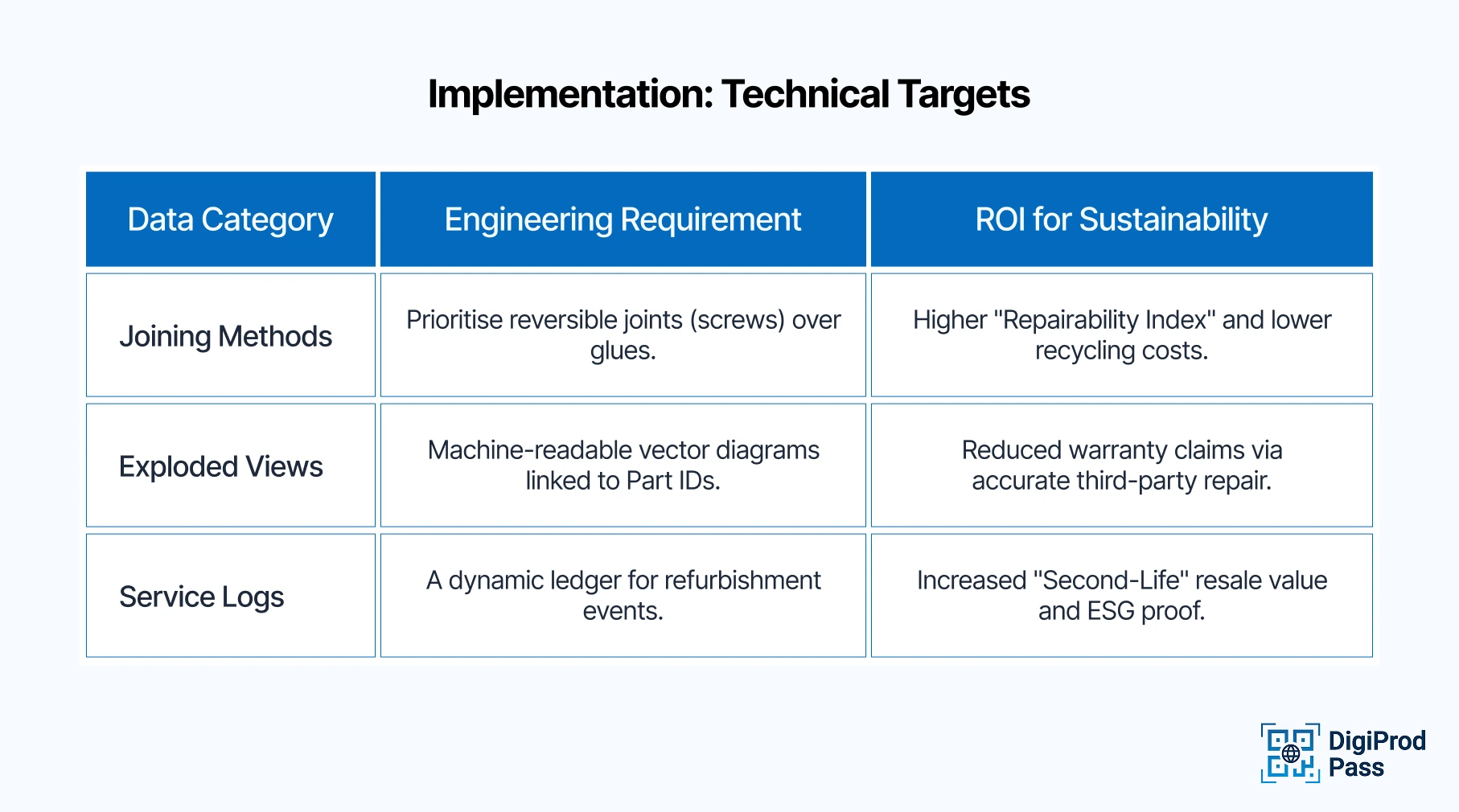
For product designers and sustainability leads, the challenge isn't just "transparency"—it’s the technical reality that by 2027, a piece of furniture’s market access will depend on a machine-readable Repairability Index. If a third-party technician can’t identify a fastener or access a spare part via your data schema, your "Ease of Repair" score fails before the product even leaves the factory.
The goal is to move the DPP beyond a digital label and into a structured blueprint for end-to-end traceability. Here is how to architect your data for the upcoming EU mandates.
Under the Ecodesign for Sustainable Products Regulation (ESPR), "Ease of Disassembly" is a measurable metric. Your data schema must specify the exact tool requirements for every internal connection.
A circular economy doesn't happen at the "Product" level; it happens at the "Part" level.
A sustainability lead’s greatest pain point is the "Ghost Part"—a component that exists in a warehouse but isn't digitally linked to the product in the field.
Building a Digital Product Passport isn't just about generating a QR code; it’s about architecting a tamper-proof record of your product’s journey. At DigiProd Pass, we bridge the gap between complex furniture engineering and EU regulatory compliance through a dedicated, modular framework.
1. Beyond the SKU: Component-Level Architecture
Our platform doesn't just track the finished item. We enable designers to map the entire fastener taxonomy and assembly sequence at the component level. By identifying every hinge, textile panel, and structural joint, we ensure your "Ease of Repair" score is backed by verifiable data.
2. Semantic Data & JRC Alignment
We move beyond static PDFs. DigiProd Pass develops passports using machine-readable, structured data (JSON-LD) that aligns with the latest JRC semantic definitions. This ensures your data is interoperable with the EU Registry and third-party repair networks from day one.
3. Tamper-Proof Traceability
Using our secure architecture, we provide end-to-end transparency without compromising your proprietary design data.
4. Integration with Your Supply Chain
DigiProd Pass integrates directly with your existing inventory and PIM systems via API. This turns your spare parts catalog into a live "Spare Parts Ledger," allowing technicians to scan a product and instantly see lead times for replacement components.
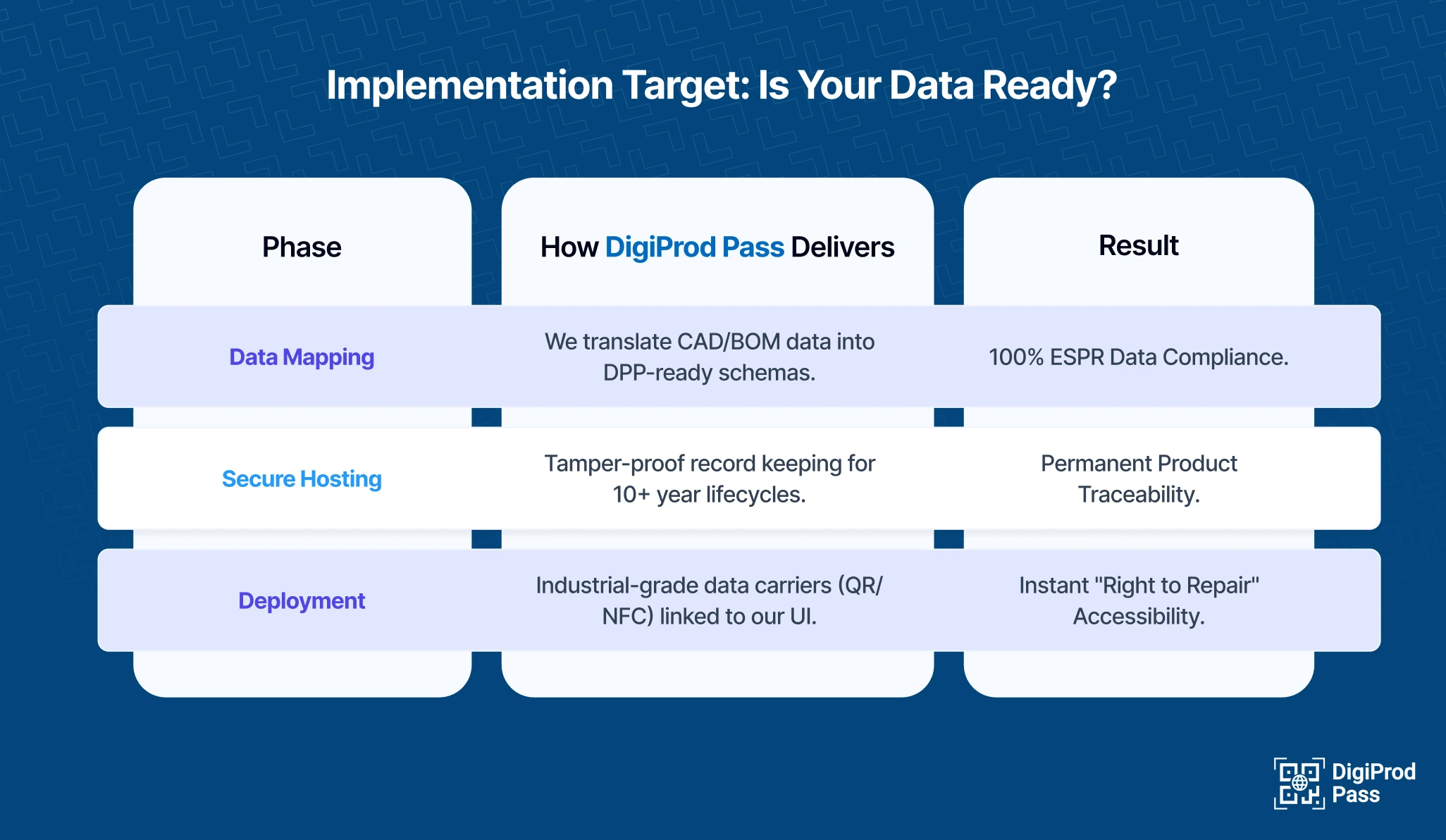
All DigiProd Pass deployments are architected to meet the data retention requirements of the ESPR, ensuring your furniture's digital record persists for its entire functional lifecycle—typically 10 to 15 years.
Ready to pilot your first Furniture DPP? Contact our technical team to begin mapping your repairability data.
The furniture DPP is the bridge between a physical product and its second, third, and fourth lives. By adopting the JRC’s semantic definitions and focusing on the physicality of the repair—the tools, the sequence, and the component-level data—you aren't just checking a box for the EU. You are building the digital infrastructure that ensures your furniture stays in the economy and out of the landfill.
Next Step: Review your current CAD exports. If your "exploded views" aren't already linked to a parts database, that is the first technical gap to close before the 2027 deadlines.
Q: Is a PDF manual enough for ESPR compliance?
A: No. The latest JRC (Joint Research Centre) guidelines emphasise that DPP data must be machine-readable and structured (e.g., JSON-LD). Static documents like PDFs are considered "non-compliant" for core repairability and material data fields.
Q: Do I need unique IDs for every single screw?
A: No. Data granularity is required at the component level (e.g., a modular seat cushion or a gas lift). Fasteners should be documented in the "Fastener Taxonomy" of the parent product rather than carrying individual digital IDs.
Q: When will these requirements become mandatory for furniture?
A: While the framework is active, furniture-specific "Delegated Acts" are expected by 2028. However, horizontal requirements for repairability scoring are being piloted now, meaning designers should align their schemas immediately.
Sources & Technical References:
.svg)

.svg)


.svg)
.svg)





%202026_1310.webp)