
.svg)

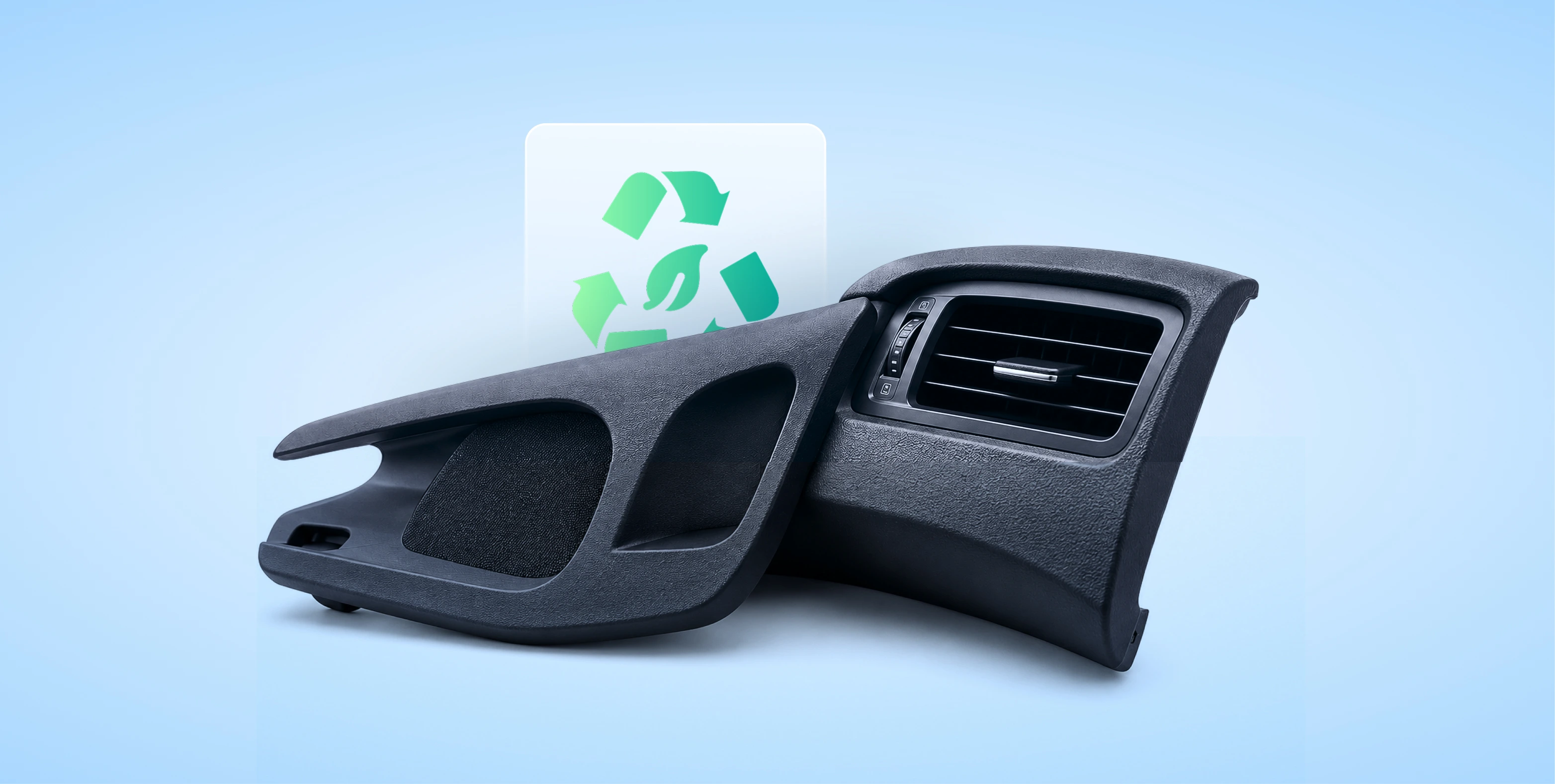
A Tier 1 automotive supplier switches a vehicle interior component to a recycled polymer. The technical datasheet says recycled content. The OEM's sustainability report counts it toward circular material targets. None of it is a lie, but from August 2026 onwards, none of it is enough without verified documentation behind every claim in the chain.
For manufacturers and brands working with automotive plastics, this is an immediate operational question, not a future compliance exercise. Two EU regulations are closing the gap between what companies claim about their materials and what they can actually prove: the Packaging and Packaging Waste Regulation (PPWR), Regulation (EU) 2025/40, applying from 12 August 2026, and the Empowering Consumers for the Green Transition Directive (ECGT), Directive 2024/825/EU, enforcing from 27 September 2026.
If you manufacture, import, or distribute packaging for automotive components on the EU market, at any tier of the supply chain, PPWR applies to you. Tier 1 and Tier 2 suppliers, OEM delivery operators, importers of finished parts, and smaller aftermarket suppliers are all in scope. Company size does not exempt you from the Declaration of Conformity requirement. If your packaging enters the EU market after 12 August 2026, it must comply.
If your company makes any environmental claim about automotive materials, components, or packaging — on datasheets, product listings, sustainability reports, or marketing communications — the ECGT applies to you. The directive does not distinguish between B2B and B2C communications. From 27 September 2026, any environmental claim without a recognised standard or independent certification behind it is a prohibited commercial practice under EU law (Directive (EU) 2024/825, Article 4; Annex I, Unfair Commercial Practices Directive 2005/29/EC as amended).
The automotive sector has moved fast on sustainable materials. Recycled polymers, bio-based plastics, and compostable compounds are appearing in vehicle interiors, under-bonnet components, and packaging for automotive parts — driven by OEM sustainability commitments and the End-of-Life Vehicles (ELV) Regulation's incoming requirements for minimum recycled content in new vehicles.
But recycled plastic claims and biodegradable plastic claims attached to these materials are now subject to legal proof obligations that most automotive supply chains are not yet built to meet.
The Packaging and Packaging Waste Regulation (PPWR), Regulation (EU) 2025/40, is a directly applicable EU regulation establishing a single legal framework for all packaging placed on the EU market. Applying from 12 August 2026, it covers all packaging types and all economic operators regardless of company size or country of establishment. From that date, manufacturers must hold a Declaration of Conformity (DoC) — a product-specific document proving packaging meets PPWR's material and sustainability requirements. Technical documentation must be stored for five to ten years and made available to market surveillance authorities within ten days. PPWR also bans PFAS in food-contact packaging from 12 August 2026 (Article 5, Regulation (EU) 2025/40) and restricts compostable packaging to a narrow permitted list under Article 9. General plastic packaging positioned as compostable outside that list is not simply an unsubstantiated claim — it may be a non-compliant use of material under the regulation itself. (Source: Regulation (EU) 2025/40, EUR-Lex; European Commission Guidance Document C(2026)3702)
The Empowering Consumers for the Green Transition Directive (ECGT), Directive (EU) 2024/825, prohibits unsubstantiated environmental claims across all 27 EU member states from 27 September 2026. It amends the Unfair Commercial Practices Directive (2005/29/EC) to blacklist generic terms such as 'environmentally friendly', 'eco-friendly', 'green', 'nature's friend', 'ecological', 'environmentally correct', 'climate friendly', 'gentle on the environment', 'carbon friendly', 'energy efficient', 'biodegradable', 'biobased', or similar statements that suggest or create the impression of excellent environmental performance, all prohibited without recognised certification. Offset-based 'carbon neutral' claims and sustainability labels without independent third-party verification are also blacklisted, automatically, with no case-by-case review required. (Source: Directive (EU) 2024/825, Annex I, EUR-Lex)
Context matters: a term like 'biodegradable' used alone on a label or datasheet is prohibited. The same term accompanied by a specific standard, certification, and certifying body is not, because the claim is substantiated and verifiable.
These are not hypothetical risk categories. They are the actual words appearing on automotive supplier datasheets and OEM sustainability communications right now.
Most manufacturers use these terms interchangeably. EU law does not. The European Commission's policy framework on biobased, biodegradable, and compostable plastics (COM(2022)682, 30 November 2022) makes clear that a bio-based plastic is not automatically biodegradable, and a biodegradable plastic is not automatically compostable.
Under EU rules, 'compostable' refers specifically to industrial composting under controlled conditions, tested against EN 13432:2000 — the recognised certification standard for compostable packaging in the EU. A material must:
All four tests must be passed simultaneously. Recognised EN 13432 certifiers include TÜV Austria (OK Compost Industrial) and DIN CERTCO. EN 13432 is due for revision under PPWR Recital (58) and Article 9(6), but the 2000 edition remains the operative standard until a revised version is formally adopted.
The automotive sector faces a more complex version of the PPWR ECGT documentation challenge than most industries. A recycled polymer used in a vehicle interior component may travel through a chemical recycler, compounder, Tier 2 injection moulder, Tier 1 assembler, and OEM before reaching the finished vehicle. At each stage, the material's sustainability credentials, recycled content percentage, feedstock origin, processing method, EN 13432 certification status, need to be documented and passed along the automotive supply chain traceability record.
A supplier declaration that the material 'meets EN 13432' or 'contains 40% recycled content' is not documentation. The certificate number, the certifying body, the test results, and the chain of custody from the polymer to the finished component must all be available in a retrievable format. Under PPWR, failure to produce that documentation within ten days of a market surveillance request is a compliance failure — regardless of whether the material actually meets the claimed standard.
For sustainability managers who led the original materials switch, this is where the gap most often appears. The decision was sound. The supplier relationship is in place. But the certification reference, the test results, and the chain of custody were never formally collected or stored. That gap between a well-intentioned materials switch and a legally defensible claim is what August 2026 exposes.
Neither PPWR nor ECGT mandates a Digital Product Passport for automotive packaging. The immediate compliance tools are PPWR's Declaration of Conformity and ECGT's certification requirements. What the DPP provides is the data infrastructure that makes PPWR ECGT compliance significantly easier to maintain, audit, and scale across complex automotive supply chains — a structured, tamper-evident record that travels with the material through each transformation, attaching feedstock origin, recycled content percentage, processing method, EN 13432 certification reference, and chain of custody to a unique identifier accessible at every stage of the product lifecycle.
Packaging DPP delegated acts under ESPR are anticipated for 2028–2029. The data a packaging DPP will eventually require is the same data required for PPWR compliance today — material composition, recyclability assessment, recycled content, substances of concern, and feedstock origin. PPWR and ESPR share the same digital infrastructure: the same data carriers, QR codes, and GS1 Digital Link identifiers. Companies building their documentation architecture for PPWR compliance now are completing their digital product passport automotive groundwork ahead of the 2028–2029 requirements.
DigiProd Pass is an active partner in EcoPlast, a Horizon Europe-funded project focused on circular operations in the automotive plastics value chain (Grant Agreement No 101182147). EcoPlast integrates Digital Product Passport infrastructure with advanced sorting technology and chemical recycling across automotive plastic components. Delivered by a consortium of fourteen partners across Europe — including Ford Otosan, Centro Ricerche Fiat, and DigiProd Pass Ltd — the project addresses directly the automotive supply chain traceability challenge that PPWR and ECGT documentation requirements expose.
For organisations in automotive plastics building audit-ready documentation architecture, DigiProd Pass provides Digital Product Passport solutions designed to make supply chain data structured, verifiable, and ready for market surveillance — across the material lifecycle, not just at the point of sale.
FAQs
1. What is a Declaration of Conformity, and do I need one by August 2026?
Yes. From 12 August 2026, every packaging type placed on the EU market requires a signed Declaration of Conformity (DoC) backed by technical documentation, retained for five to ten years and available to market surveillance authorities within ten days. There is no grace period and no size exemption.
2. Can automotive packaging still be labelled biodegradable or compostable after 2026?
Only with recognised certification. From 27 September 2026, generic biodegradable claims without an independent standard, such as EN 13432:2000, are prohibited under the ECGT. Under PPWR Article 9, compostable packaging is only permitted for specific applications — outside that list, the claim may be a non-compliant use of material, not simply unsubstantiated.
3. What are the penalties for non-compliance with PPWR?
PPWR does not set EU-wide fines — penalties are determined by each member state's market surveillance authority under Article 47 of Regulation (EU) 2025/40, and must be effective, proportionate, and dissuasive. The most immediate consequence is market access: non-compliant packaging cannot be placed on the EU market after 12 August 2026 and can be blocked or recalled. In Germany, violations of registration or reporting obligations can result in fines of up to €200,000 plus sales bans. For environmental claims specifically, the Empowering Consumers Directive allows member states to impose penalties proportionate to the harm caused — with the UK's equivalent regime under the DMCC Act 2024 imposing fines of up to 10% of global annual turnover or £300,000, whichever is greater, as a comparable benchmark.
Sources
Regulation (EU) 2025/40 — EUR-Lex
European Commission Guidance Document C(2026)3702 on PPWR, 30 March 2026
Directive 2024/825/EU (ECGT) — Official Journal of the European Union, 6 March 2024
COM(2022)682 — EU policy framework on biobased, biodegradable and compostable plastics, 30 November 2022EcoPlast Project — Horizon Europe
EN 13432:2000, European Committee for Standardisation; COM(2022)682, European Commission, 30 November 2022
.svg)

.svg)


.svg)
.svg)


%202026_1310.webp)