


The European Commission must have the EU Digital Product Passport Registry live by 19 July 2026, under Article 13 of the Ecodesign for Sustainable Products Regulation (EU) 2024/1781. What it actually stores is a unique identifier and, where relevant, a commodity code — nothing else. Your product data stays exactly where it already is, on your systems or with your DPP service provider.
That's a smaller footprint than most brands expect, but it still changes four things inside your organisation. Here's what they are.
The EU DPP Registry is a central directory, run by the European Commission, that stores the unique identifiers of every product with a Digital Product Passport. It stores two things: unique identifiers and commodity codes for imported goods. It does not store the Digital Product Passport itself.
Article 13(1) of the ESPR spells this out directly. The Commission must set up a secure registry that stores, at a minimum, the unique identifier of every product that has a Digital Product Passport. If that product is entering the EU under "release for free circulation," the registry also stores its commodity code. Batteries get a specific mention too — the same article points directly to Article 77(3) of the Battery Regulation (EU) 2023/1542, which means battery passports run through this same registry.
Think of the registry as a directory, not a filing cabinet. When a customs officer or market surveillance authority looks up a product, the registry tells them the identifier exists and is valid. It doesn't hand over your product's actual sustainability data, materials list, or supply chain information. That stays where you put it.
There are two identifiers in play here, and it's worth keeping them separate because they're easy to conflate:
One detail here matters more than it sounds like it should: Article 13(5) states plainly that this confirmation "shall not be deemed to be proof of compliance with this Regulation or other Union law." In other words, getting your registration identifier back means your upload worked. It doesn't mean your Digital Product Passport is legally compliant. Those are two separate things, and the regulation says so directly.
The registry's contents aren't fixed forever, either. Article 13(2) allows the Commission to add more required fields later, through delegated acts, but only if a new field meets one of three tests: it helps verify that a passport is genuine, it makes market surveillance or customs checks more effective, or it doesn't create a disproportionate administrative burden for businesses or customs authorities. So expansion is possible, but it isn't arbitrary.
Once the registry is live, four things change in practice — regardless of when your sector's own registration duty actually starts. Building these into your plan now saves you from being confused later.
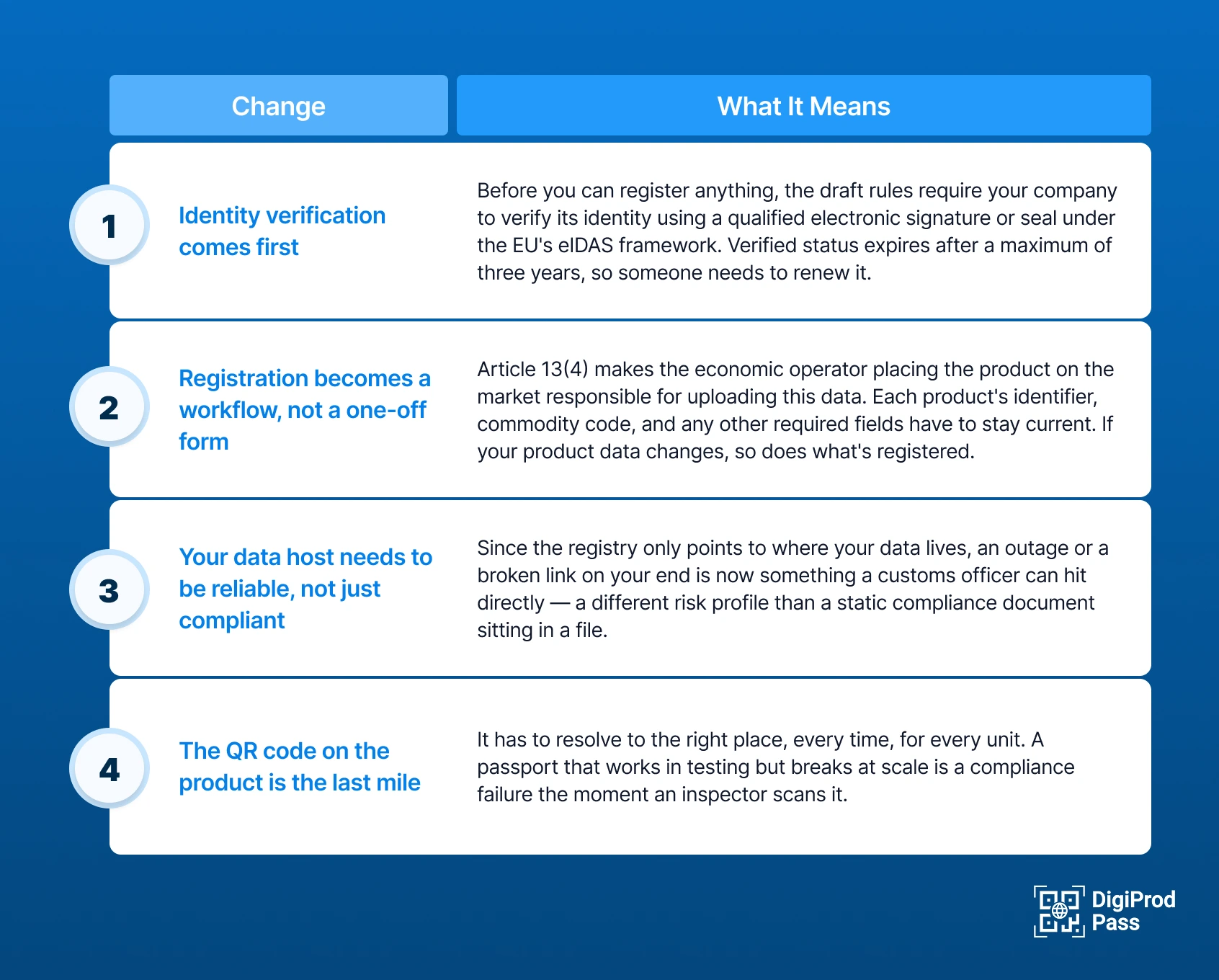
Points 2 and 3 are where most of the real work sits. A single product line can generate dozens of small data changes as suppliers update materials, certifications, or compliance status — and every one of those changes needs to reach your registered record, not just sit in an internal spreadsheet. A system of record that maps your supply chain hierarchically, rather than treating each supplier as a disconnected entry, is what keeps this data current without someone manually re-submitting it every time something upstream shifts.
Full automatic customs checks don't switch on the day the registry goes live. That part comes later.
Under Article 21 of the ESPR, once the registry is operational, releasing a covered product for free circulation requires giving customs its unique registration identifier. Customs can only release the product once the identifier and its commodity code are confirmed against the registry.
But the fully automated version of this check — the one most people picture — depends on the registry connecting to the EU Customs Single Window (CSW-CERTEX). That connection has up to four years from the relevant implementing act's entry into force to actually happen. So the registry going live in 2026 and automated customs enforcement going live are two separate milestones, years apart.
None of this is urgent, but none of it is quick to fix later either.
The question isn't "how do I upload my data to the EU?" It's simpler than that: Am I verified? Is my identifier registered? Is my data host reliable? And does the QR code on my product lead to the right place?
What is the EU DPP Registry? A central directory the European Commission must set up under Article 13 of the ESPR. It stores unique identifiers and commodity codes for products with a Digital Product Passport.
Does the EU DPP Registry store my product data? No. It stores identifiers and commodity codes only. Your actual product data stays with you or your DPP service provider.
Do I have to register my products by 19 July 2026? For most businesses, no. That date is when the Commission's registry infrastructure must be ready. Registration duties arrive sector by sector, tied to each product category's own delegated act.
Does getting a registration identifier mean my product is compliant? No. Article 13(5) states that receiving a registration identifier confirms your upload succeeded — it is not proof of compliance with the ESPR or any other EU law.
What is eIDAS verification and why does it matter for the DPP Registry? eIDAS is the EU's framework for electronic identification. Under the draft Implementing Regulation, your organisation must verify its identity with a qualified electronic signature or seal before registering products. That verification must be renewed at least every three years.
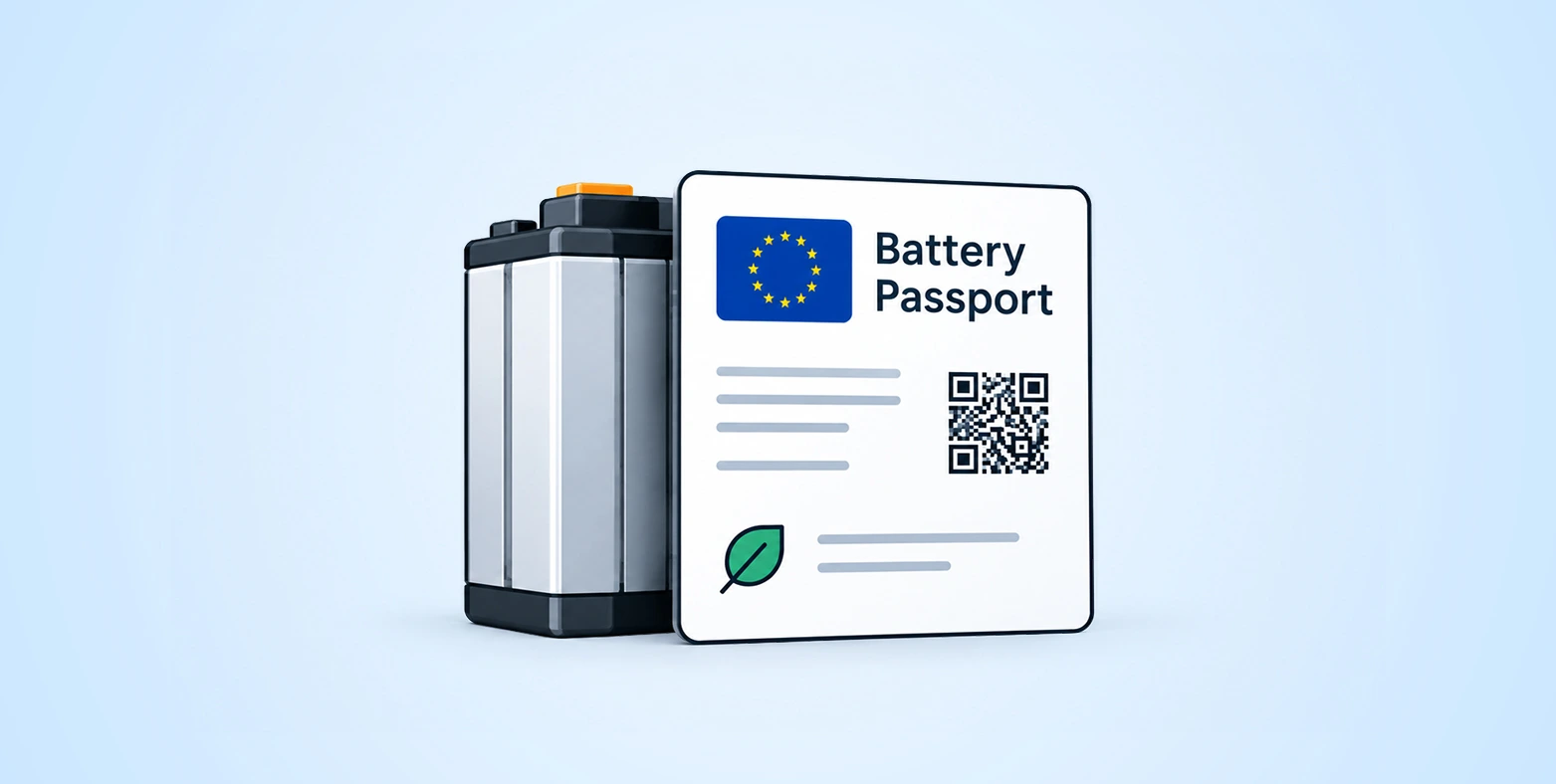
When does the Battery Regulation require the use of a registry? From 18 February 2027, under Article 77 of the Battery Regulation (EU) 2023/1542, battery passports will become mandatory and must be registered in the same registry.
.svg)

.svg)


.svg)
.svg)



%202026_1310.webp)