
.svg)

.webp)
A Digital Product Passport (DPP) is a digital identity record for a product, component or material. It connects the physical product to structured information about its origin, materials, compliance, environmental performance, repair and end-of-life handling. The EU DPP Registry became operational on 20 July 2026, while the first mandatory passports apply to specified battery categories from 18 February 2027. Other product groups will follow through sector-specific legal acts and transition periods.
For manufacturers, importers and suppliers, this means preparing product identifiers, supply-chain information, environmental data and secure data-sharing processes before requirements become applicable to their product categories. This guide explains how Digital Product Passports work, which products are affected and how organisations can prepare.
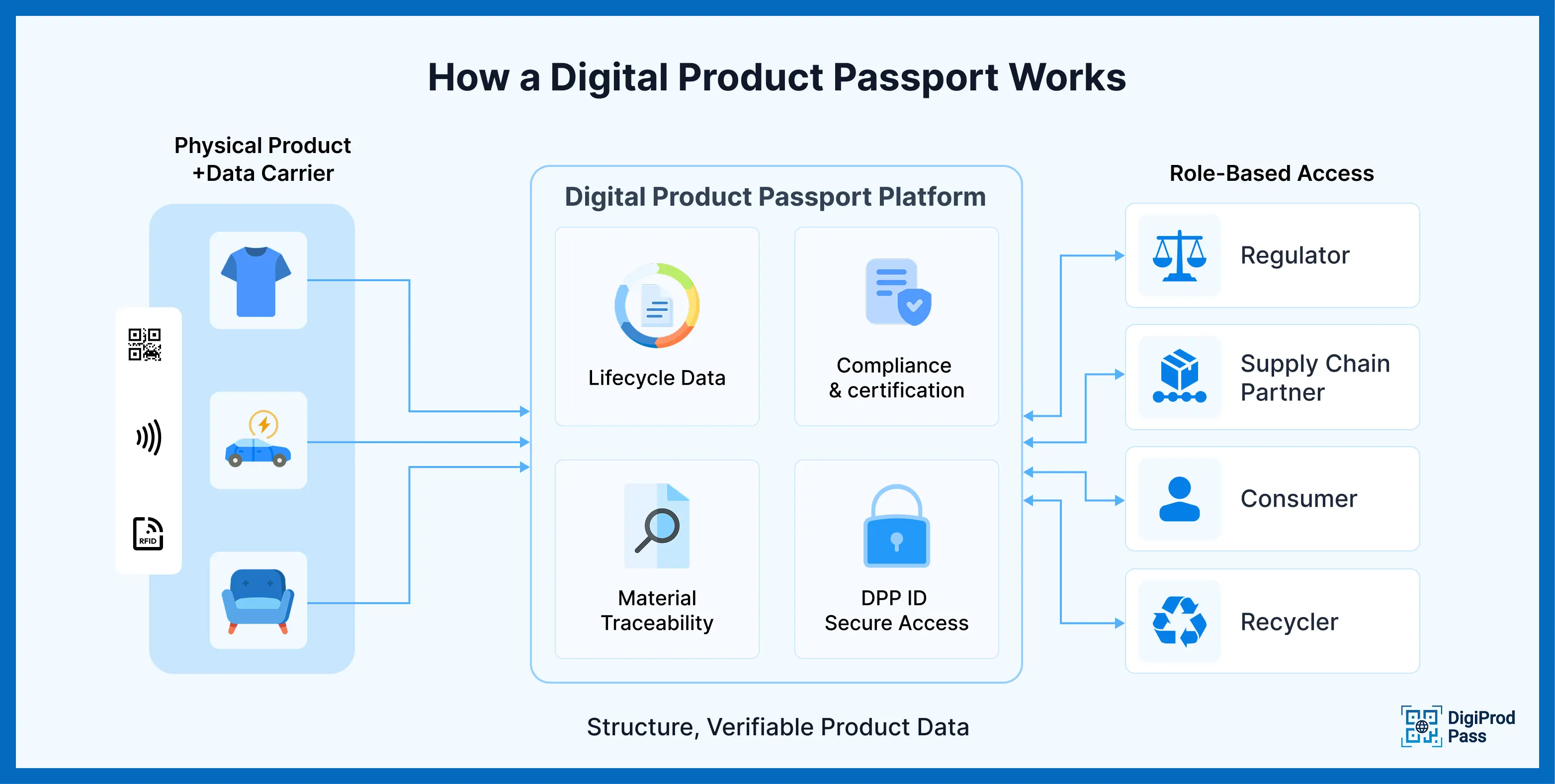
A DPP links a physical product to a structured digital source through a data carrier such as a QR code, NFC tag or another machine-readable identifier. The exact information, access rights and technical requirements will be defined through the legislation applicable to each product group.
Important: A DPP cannot be a static webpage or a simple PDF. It must utilise a Unique Product Identifier (UPI), rely on decentralised or highly secure data storage, and adhere to global interoperability protocols including ISO/IEC 15459 standards.
Depending on the delegated act applicable to your industry, a compliant DPP must contain:
The DPP operates on a multi-tiered access system. It segments proprietary supply chain data so that regulators, supply chain partners, and end-consumers each access only the layer of information relevant to them.
The rollout of the Digital Product Passport is no longer a distant policy discussion — it is an active, structural shift in global trade.
With battery passport requirements entering phased enforcement in 2026 and delegated acts for textiles, electronics, and construction progressing through their final adoption stages, the window for early preparation is narrowing. Brands placing goods on the EU market — whether headquartered in Europe or managing complex global supply chains — should be building DPP infrastructure now.
Treating the DPP purely as a compliance checkbox is a missed opportunity. When implemented with robust technology — including blockchain verification and API integrations — Digital Product Passports transform fragmented supply chains into transparent, verifiable data assets. This enables enterprise brands to:
The Digital Product Passport is not an isolated initiative. It is the technological enforcement mechanism of the Ecodesign for Sustainable Products Regulation (ESPR), which officially entered into force on 18 July 2024.
Source: ESPR — Regulation (EU) 2024/1781 · European Commission ESPR overview
Under the broader European Green Deal and the Circular Economy Action Plan (CEAP), the ESPR replaces the outdated Ecodesign Directive, which primarily focused on energy-related products. Its new mandate is vastly expanded: to ensure that almost all physical goods placed on the EU market are durable, repairable, recyclable, and environmentally transparent.
The DPP serves as the standardised data carrier to enforce this. It shifts the burden of proof from post-market regulatory audits to pre-market digital compliance. Without a valid, functioning DPP linked to the central EU Registry — slated for operational launch by July 2026 — products will face barriers to clearing customs and entering the single market.
Source: EU DPP Registry framework — European Commission
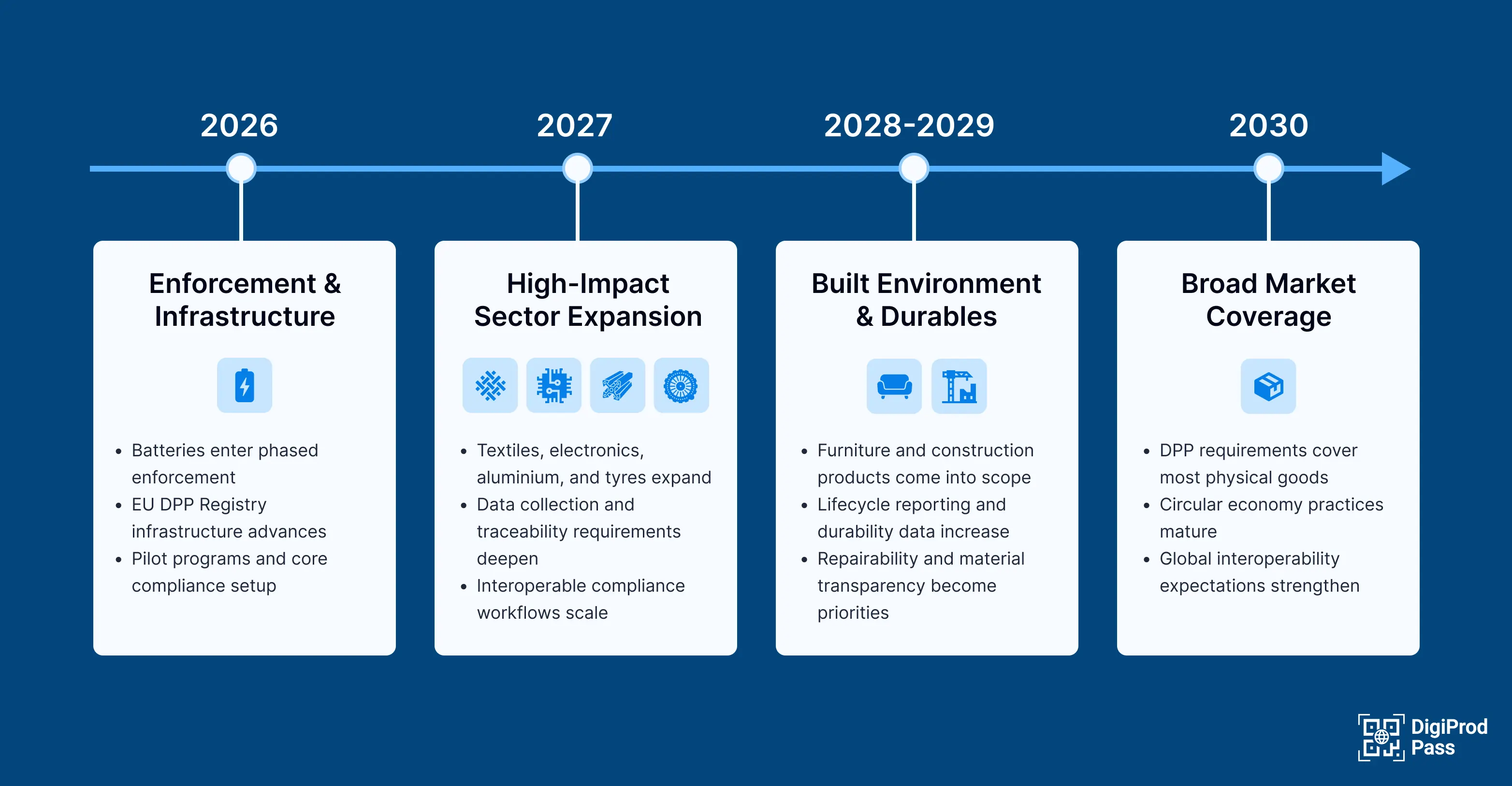
The Digital Product Passport rollout will not apply to every product category at the same time. Under the Ecodesign for Sustainable Products Regulation (ESPR), product-specific requirements will be introduced through delegated acts, which may define what product information must be provided, how it should be accessed, and whether the Digital Product Passport is the main vehicle for that information. The European Commission’s first ESPR and Energy Labelling Working Plan for 2025–2030 identifies priority product groups and indicative timelines for regulatory work, but individual requirements will only become binding once the relevant delegated acts are adopted.
Source: ESPR Work Plan 2022–2024 — European Commission
2026: Infrastructure, Batteries Readiness, and First ESPR Measures Battery passport preparation:
The EU Battery Regulation is already in force, but the mandatory digital battery passport does not begin in 2026. Under Article 77 of Regulation (EU) 2023/1542, the battery passport requirement applies from 18 February 2027 to each LMT battery, each industrial battery with a capacity above 2 kWh, and each electric vehicle battery placed on the market or put into service. For affected battery manufacturers, importers, and supply chain partners, 2026 should therefore be treated as the critical year for data readiness, lifecycle data collection, QR/data carrier workflows, and supplier integration.
DPP Registry infrastructure:
Under ESPR Article 13, the European Commission must establish the Digital Product Passport Registry by 19 July 2026. This registry is intended to store unique identifiers and support DPP registration and lookup. It should not be described as a central database that stores all proprietary product data; the DPP model is designed around controlled access to product information, with rules on identifiers, data carriers, access rights, registry functions, and a web portal being developed by the Commission.
First ESPR product priorities and unsold goods rules:
The first ESPR Working Plan identifies iron and steel as an intermediate product group with an indicative 2026 timeline for adoption work. Separately, the Commission has adopted delegated and implementing acts on the destruction of unsold consumer products, including rules for unsold apparel, clothing accessories, and footwear. The ban on destruction of those unsold textile and footwear products applies to large companies from 19 July 2026, while standardised disclosure rules apply from February 2027.
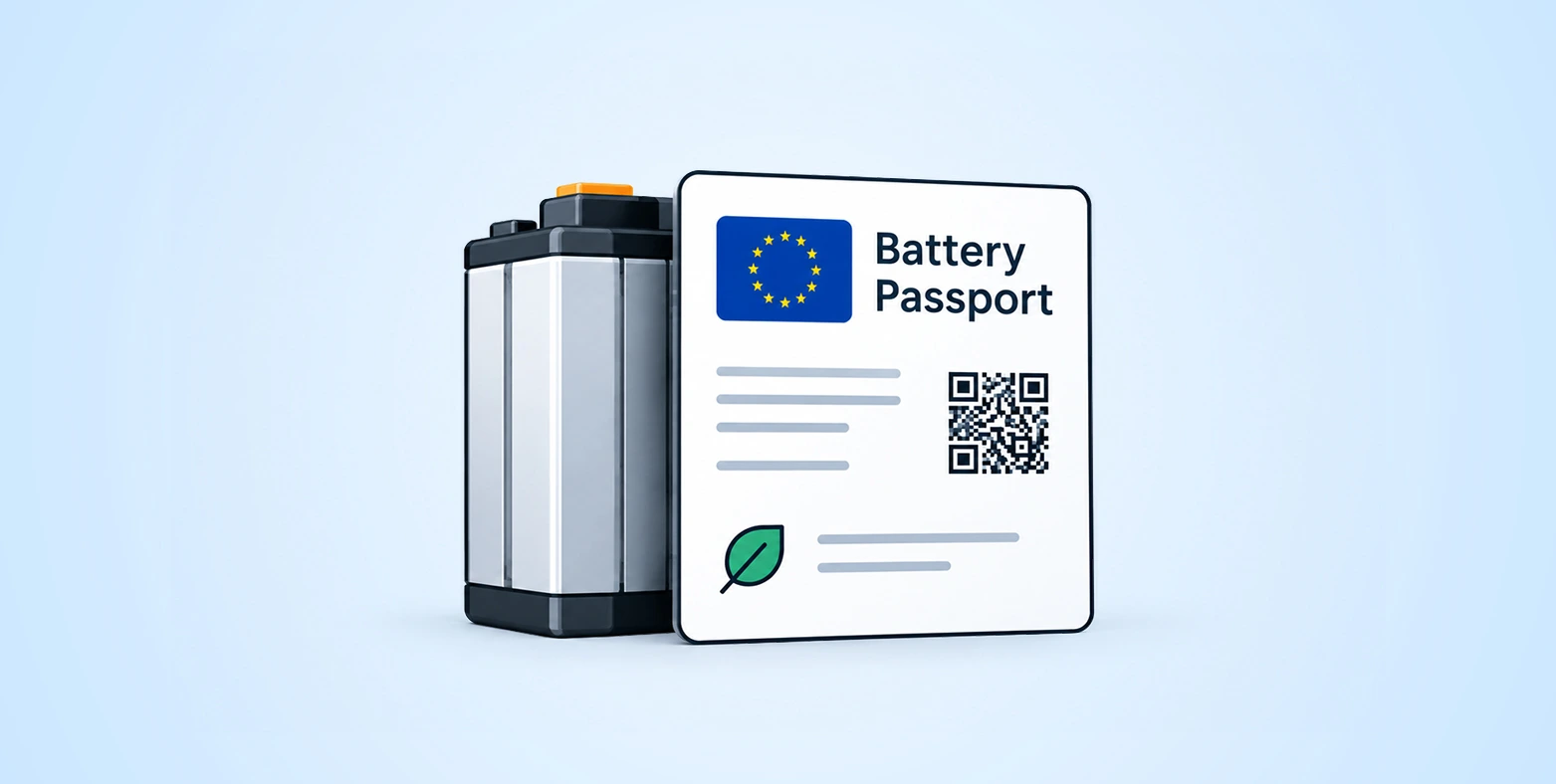
The first legally fixed DPP-style deadline is the battery passport under the EU Battery Regulation. From 18 February 2027, LMT batteries, industrial batteries above 2 kWh, and electric vehicle batteries must have a battery passport containing the required battery information. This makes batteries the clearest near-term DPP compliance priority for companies placing relevant batteries on the EU market.
Textiles, tyres, aluminium, and repairability measures:
The ESPR Working Plan gives an indicative 2027 adoption timeline for several priorities: textiles/apparel, tyres, aluminium, and horizontal repairability requirements, including possible repairability scoring. For textiles/apparel, the Working Plan highlights the sector’s high potential to improve product lifetime extension, material efficiency, and environmental impacts such as water use, waste generation, climate change, and energy consumption. However, it is safer to say that regulatory adoption work is expected around 2027, not that full DPP compliance is automatically required in 2027.
Electronics and ICT:
ICT products and other electronics are not listed as one standalone product group in the first ESPR Working Plan’s main priority table. Instead, the Commission states that ICT products will be covered through work on horizontal requirements, including repairability and recycled content/recyclability of electrical and electronic equipment. The Working Plan gives an indicative 2027 timeline for repairability measures and 2029 for recycled content and recyclability requirements for electrical and electronic equipment.
Furniture and mattresses:
The ESPR Working Plan gives an indicative 2028 adoption timeline for furniture and 2029 for mattresses. The regulatory focus is expected to include durability, resource efficiency, material information, repairability, recyclability, and product information requirements. Any DPP obligation for these sectors will depend on the final delegated acts adopted for the relevant product groups.
Electrical and electronic equipment:
The Working Plan identifies horizontal requirements on recycled content and recyclability of electrical and electronic equipment with an indicative 2029 adoption timeline. This means electronics should remain a strategic preparation area, but the exact DPP data fields, scope, and compliance dates will depend on future legal acts.
Construction products:
Construction products are also moving toward a DPP model, but primarily through the revised Construction Products Regulation, Regulation (EU) 2024/3110, rather than the ESPR Working Plan alone. The Commission’s first CPR Working Plan for 2026–2029 states that the digital product passport is a key pillar of the CPR, and that every product regulated by harmonised technical specifications or European Assessment Documents under the new CPR will have a DPP once the system is operational and made mandatory by delegated act. Construction DPPs are expected to support traceability, access to product and material information, safe use, repair, reuse, recycling, and disposal information.
By 2030, the EU’s sustainable products framework is expected to be significantly broader, but it is not accurate to claim that nearly all physical goods will automatically require a fully functional DPP by 2030. The ESPR has a broad scope and allows requirements to be set for many categories of physical goods, but actual obligations will depend on the adoption of product-specific or horizontal delegated acts. The 2025–2030 Working Plan is the first phase of prioritisation, covering selected product groups such as iron and steel, aluminium, textiles/apparel, furniture, tyres, mattresses, and certain horizontal measures.
Companies should therefore treat 2026–2030 as the period for building DPP-ready infrastructure: product identifiers, supplier data collection, lifecycle assessment data, material traceability, access-control models, and API integrations with ERP, PLM, and compliance systems. The exact compliance timeline will vary by product group and should be monitored through EUR-Lex, European Commission ESPR updates, and sector-specific delegated acts.
The ESPR deliberately casts a wide net. It is a misconception that only EU-based manufacturers bear the burden of DPP compliance. The regulation targets the placement of products on the market, meaning the legal obligation cascades across the entire global value chain.
Whether headquartered in Germany, Bangladesh, or the United States, the entity that designs and manufactures the product — or markets it under their own trademark — is the primary duty holder. They are responsible for generating the DPP, conducting the conformity assessment, and aggregating data from upstream suppliers. They must ensure the product's unique identifier correctly links to a secure, decentralised data host.
If a product is manufactured outside the EU, the EU importer takes on significant legal liability. Importers are explicitly barred from placing non-compliant goods on the market. They must independently verify that the foreign manufacturer has created a valid DPP, that the physical data carrier (QR/NFC) is functioning, and that the digital data aligns with customs declarations. Distributors and retailers must then ensure the DPP remains accessible to the end-consumer at the point of sale.
Raw material extractors, processing facilities, and component suppliers can no longer operate in the dark. Because the manufacturer requires verified Product Carbon Footprint (PCF) and material origin data to build the passport, upstream suppliers are required to digitally transmit their site-level data, chemical compliance, and ESG attributes downstream. Failure to provide this structured data will result in suppliers being cut out of EU-bound supply chains.
Because the ESPR mandates a decentralised architecture — meaning the EU will not host the actual proprietary data, only the registry of identifiers — technology providers are the critical bridge. Compliant DPP platforms provide the traceability software, blockchain verification, and API integrations necessary to pull siloed data from existing ERP and PLM systems and package it into a compliant, interoperable format.
The technical requirements of a DPP are not one-size-fits-all. The European Commission has tailored the delegated acts to address the specific environmental bottlenecks of individual industries.
The fashion industry faces some of the most aggressive new transparency rules, aimed at curbing fast-fashion waste. By the expected 2027 enforcement date, apparel DPPs must trace the entire journey of a garment.
As the first category entering phased enforcement (2026), the Battery Passport has set the structural precedent for all future DPPs. It applies to industrial, EV, and LMT batteries over 2 kWh.
The ESPR mandates that consumer and commercial furniture prove their longevity and repairability.
Many brands mistakenly assume a DPP is a QR code linking to a marketing landing page. This is a critical error. Under the ESPR, the data architecture must be decentralised, immutable, and interoperable. Building this infrastructure requires three core technical pillars:
The EU will not store your product data — it will only maintain the registry of Unique Product Identifiers. Manufacturers must host their own data through decentralised or highly secure architectures that prevent tampering and greenwashing.
Blockchain and distributed ledger technology (DLT) provide an immutable, cryptographically secure record of supply chain events. Crucially, through selective disclosure protocols, blockchain allows manufacturers to prove compliance to a regulator without exposing their confidential supplier list to competitors or the public.
Relevant standard: ISO/IEC 27001 — Information Security Management
Most legacy sustainability reporting relies on static, retrospective averages. A compliant DPP requires continuous, product-level Lifecycle Assessment metrics. The architecture must dynamically calculate the Product Carbon Footprint (PCF) as the product moves through extraction, manufacturing, and transport — rather than relying on industry-wide estimates.
Relevant standard: ISO 14067 — Carbon Footprint of Products
Supply chains run on hundreds of different software systems. A compliant DPP must be able to exchange data across all of them. Technically, this means:
• Unique identifier alignment: Compliance with ISO/IEC 15459 for unique product identifiers, ensuring each DPP can be unambiguously located within the EU Registry.
• Carbon footprint reporting: Alignment with ISO 14067 standards for verified, product-level carbon data.
• ERP/PLM integration: Seamless API connectivity with existing enterprise systems such as SAP or Oracle, so DPP data is drawn from live operational sources — not manually entered.
Relevant standards: ISO/IEC 15459 — Unique Identifiers · ISO 14067 — Carbon Footprint of Products
The following questions reflect the most common queries from enterprise compliance teams, supply chain leaders, and procurement managers preparing for ESPR requirements.
The primary consequence of failing to provide a valid Digital Product Passport is denial of market access. Products without a compliant DPP linked to the central EU Registry will not clear customs and cannot legally be sold within the European Union.
Beyond market exclusion, individual EU member states are required to establish their own financial penalty frameworks for companies found to be supplying fraudulent, incomplete, or non-functional DPP data. Penalty levels will vary by member state but are expected to be substantial.
Source: ESPR Article 68 — Market surveillance and penalties
No. While the European Commission has committed to developing support tools for SMEs, there is no blanket exemption from DPP obligations.
More importantly, because the ESPR holds the primary manufacturer responsible for aggregating the entire value chain's data, enterprise brands will contractually require their SME suppliers to provide structured digital compliance data. SMEs that cannot integrate with upstream DPP systems risk being cut from EU-bound supply chains regardless of their regulatory status.
Source: European Commission SME support under ESPR
A Lifecycle Assessment (LCA) is a scientific methodology used to calculate the environmental impact of a product — covering factors such as carbon footprint, water usage, and raw material depletion. A Digital Product Passport (DPP) is the secure, digital infrastructure that carries that LCA data, along with other required information including the Bill of Materials, repair instructions, substances of concern, and regulatory conformity documents.
Think of the LCA as the analysis; the DPP is the auditable, machine-readable record of that analysis — permanently linked to a specific physical product.
Batteries (industrial, EV, and LMT over 2 kWh) are the first category entering enforcement under the EU Battery Regulation, with phased requirements active from 2026. High-impact sectors following in 2027 are expected to include textiles and apparel, electronics and ICT, aluminium, and tyres — based on current delegated act timelines. Furniture, construction materials, and durables are targeted for 2028–2029, with near-universal coverage expected by 2030.
Source: ESPR product prioritisation — European Commission Work Plan
The EU DPP Registry — targeted for operational launch by July 2026 — is a centralised index of Unique Product Identifiers (UPIs). It does not store the actual product data. Instead, it functions as a lookup directory: when a regulator, customs officer, or authorised third party scans a product's data carrier (QR code or NFC tag), the Registry resolves the identifier to the manufacturer's approved data host, where the DPP is stored.
This decentralised architecture means manufacturers retain control and legal responsibility for their own product data, while regulators have a standardised access pathway.
Yes — if those companies place products on the EU market. The ESPR's obligations are triggered by the act of placing a product on the EU market, not by where the manufacturer is incorporated. A brand headquartered in Bangladesh, the US, China, or any other country must comply if their products are sold within the EU. In practice, the legal liability falls on the EU importer if the non-EU manufacturer has not created a compliant DPP.
An Environmental Product Declaration (EPD) is a standardised, third-party verified document summarising the environmental performance of a product, typically used in the construction sector. It is static, periodic, and product-category focused.
A Digital Product Passport is a dynamic, unit-level digital record that is updated throughout a product's lifecycle — covering not just environmental data but also material composition, repairability, safety information, and regulatory conformity. The DPP can incorporate EPD data as one of its inputs, but it is significantly broader in scope and designed for machine-to-machine interoperability across supply chains.
With 2027 mandates approaching for high-impact sectors, 2026 is the year for infrastructure deployment. Enterprise leaders should execute the following steps:
The transition to a circular economy is the new standard for global trade. Navigating the ESPR does not have to be a bottleneck — with the right technology partner, it becomes a competitive advantage.
DigiProd Pass is an ISO 27001 and Catena-X certified DPP infrastructure provider with proven enterprise deployments across textiles, batteries, and furniture sectors.
.svg)

.svg)



.svg)
.svg)


%202026_1310.webp)