


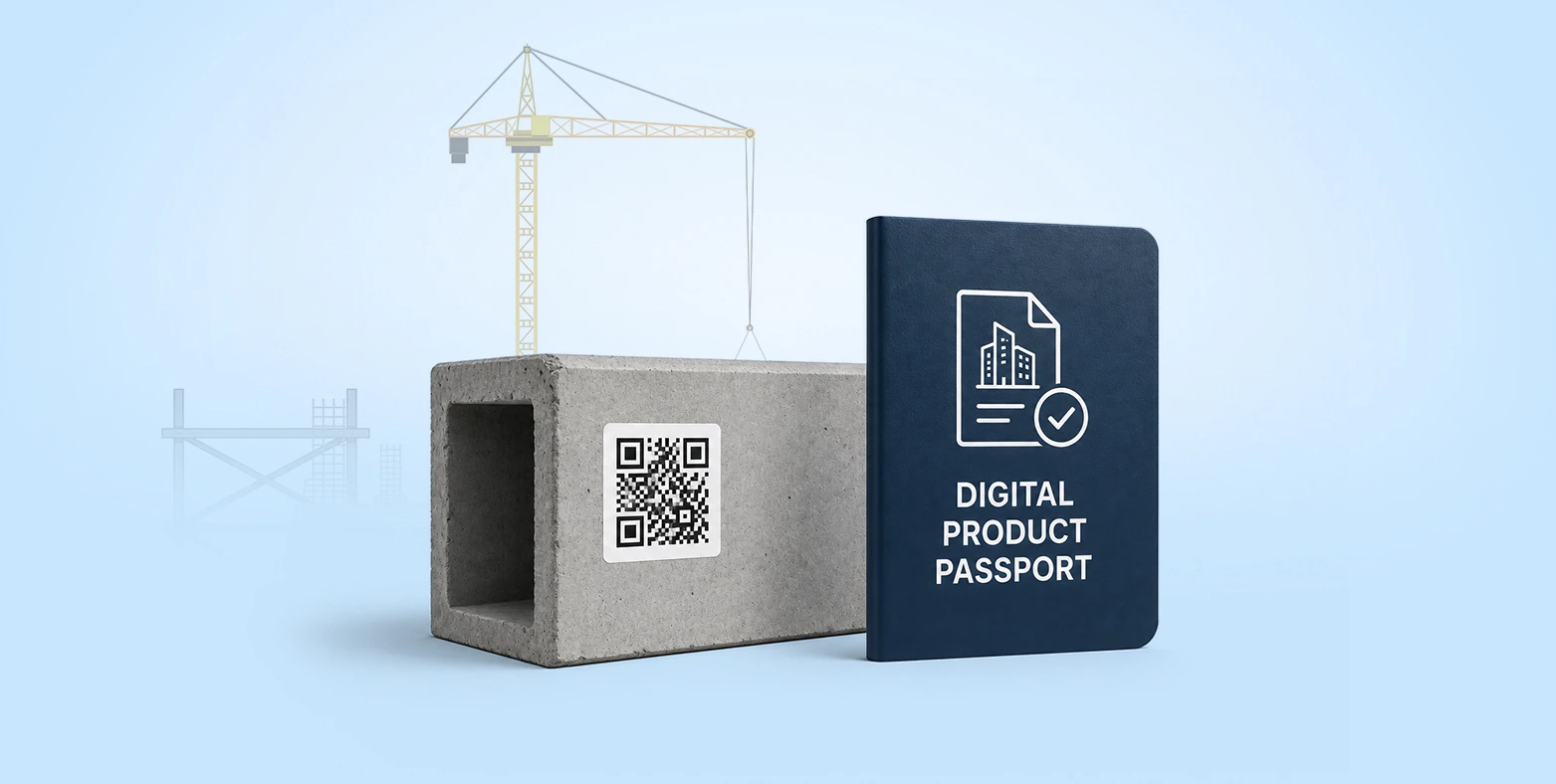
Construction products often stay in use for thirty, fifty, even eighty years. The paperwork proving they're safe and compliant rarely lasts that long. Regulation (EU) 2024/3110 addresses that gap with a Digital Product Passport (DPP) for construction products: a digital record of performance, compliance, and environmental data, built to stay accessible for as long as the product is in service. It's the sector-specific version of the EU's wider Digital Product Passport framework, established under the Ecodesign for Sustainable Products Regulation, or ESPR (Regulation (EU) 2024/1781). Construction gets its own regulation because its products, unlike most consumer goods, need to stay traceable for decades, not years.
The regulation entered into force on 7 January 2025 and became generally applicable on 8 January 2026, with the DPP system set out in Chapter X, Articles 75 to 80. It standardises how manufacturers declare safety and environmental performance, sets pre-sale requirements, and defines supply chain responsibilities (Art. 1), covering construction products broadly, including used products and key components, but excluding items such as lifts and escalators (Art. 2). Requirements roll out by "product family" rather than all at once (Art. 3).
Each product family gets its own clock, starting only once its delegated act is published.
A construction DPP is a digital record attached to a physical product, linked via a data carrier such as a QR code (Art. 3(41)), holding key characteristics, compliance documentation, and environmental data. The regulation also merges the Declaration of Performance and the Declaration of Conformity into one document, the Declaration of Performance and Conformity (DoPC), which the DPP carries forward once the product leaves the factory.
A structural beam or a sheet of insulation can sit inside a building for decades after the paperwork proving compliance was filed. A digital passport tied to a permanent product ID, rather than a filing cabinet, stays readable by whoever needs it next: a renovation contractor, a demolition crew, a building owner recovering materials, or a regulator checking compliance years later.
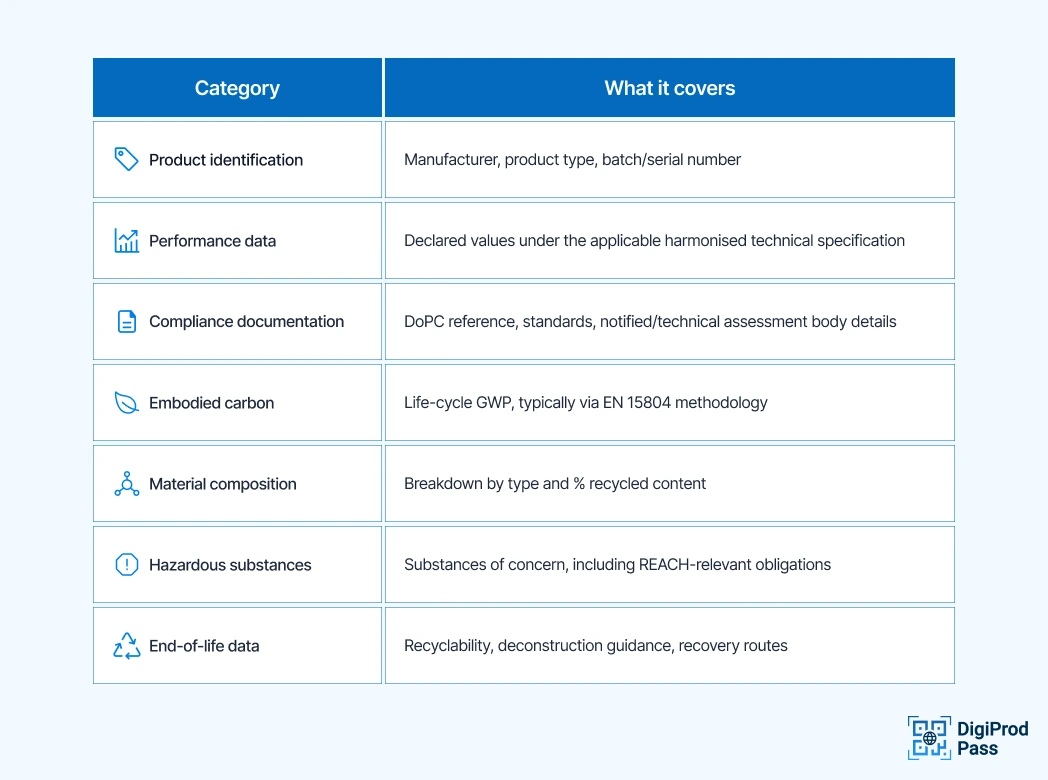
Nobody can lock down an exact list of data fields yet, since that comes from each product family's own delegated act. But based on the regulation and existing environmental standards, a few categories are already clear:
Articles 75 to 80 of Regulation (EU) 2024/3110 describe one system from six angles. Three points matter most for anyone planning on DPP for construction.
The data format is the real work: A passport must be open-standard, machine-readable, structured, searchable, and transferable without vendor lock-in (Art. 77(1)(d)), fully interoperable with other passports (Art. 78(a)), and compatible with the ESPR passport system and Building Information Modelling (Art. 75(2)(a)). Most required content, the DoPC, technical documentation, and safety information, already exists in manufacturers' compliance paperwork (Art. 76(2)(a)). The effort is converting it, not generating it from scratch, and this is the requirement least likely to carry a grace period once the delegated act lands.
Continuity is built in, and it's the detail most explainers skip: The passport system must stay accessible for 25 years after the last product of a given type reaches the market, while the individual economic operator only has to maintain it for at least 10 of those years (Art. 75(2)(i)). If that company goes insolvent, is liquidated, or stops operating in the Union, a mandatory back-up system run by DPP service providers has to keep the data available regardless (Art. 75(2)(f), Art. 78(e)). Anyone relying on a DPP service provider should confirm that provider's continuity plan covers that 15-year gap, since the regulation places the obligation on the system, not automatically on any one company.
The rollout leaves a real planning window: Six months after a delegated act enters into force, the system must be fully operational (Art. 80(1)); the mandatory-use obligation only follows at 18 months, with voluntary use permitted in between. That gap is a year to test integration against a live system before compliance is required, not dead time before anything starts.
You can also check out our blog on EU DPP regulation cheklist.
The construction DPP is fully specified, what's missing isn't the regulation, it's your preparation. Don't wait for the exact deadline: check now whether your technical documentation is already structured enough to convert, and how much of what a passport will ask for is already sitting in your EN 15804 Environmental Product Declarations. Manufacturers producing EPDs (Environmental Product Declaration) already have a head start on the carbon and material data a passport will need; the format conversion is the work to start today.
When does the construction DPP become mandatory?
There's no single deadline. Each product family's requirement starts once its delegated act is adopted (Art. 75(1)), becoming mandatory 18 months later.
Who's responsible for creating and maintaining it?
The manufacturer creates the initial passport at market entry. Keeping it current afterwards can fall to distributors, installers, or building owners, depending on the delegated act for that product family.
What happens without a valid DPP once the rule applies?
The product can't carry CE marking or be legally sold in the EU, the same enforcement route already tied to the DoPC.
What is EN 15804?
A European standard for calculating a construction product's environmental impact over its life cycle, covering embodied carbon, resource use, and waste. It ensures manufacturers' environmental claims can be compared on the same basis.
Sources:
Regulation (EU) 2024/3110 (EUR-Lex), Articles 1–4 and 75–80, Article 89
Regulation (EU) 2024/1781 (ESPR)
EN 15804 (European standard for construction product life-cycle environmental declarations)
.svg)

.svg)


.svg)
.svg)



%202026_1310.webp)