


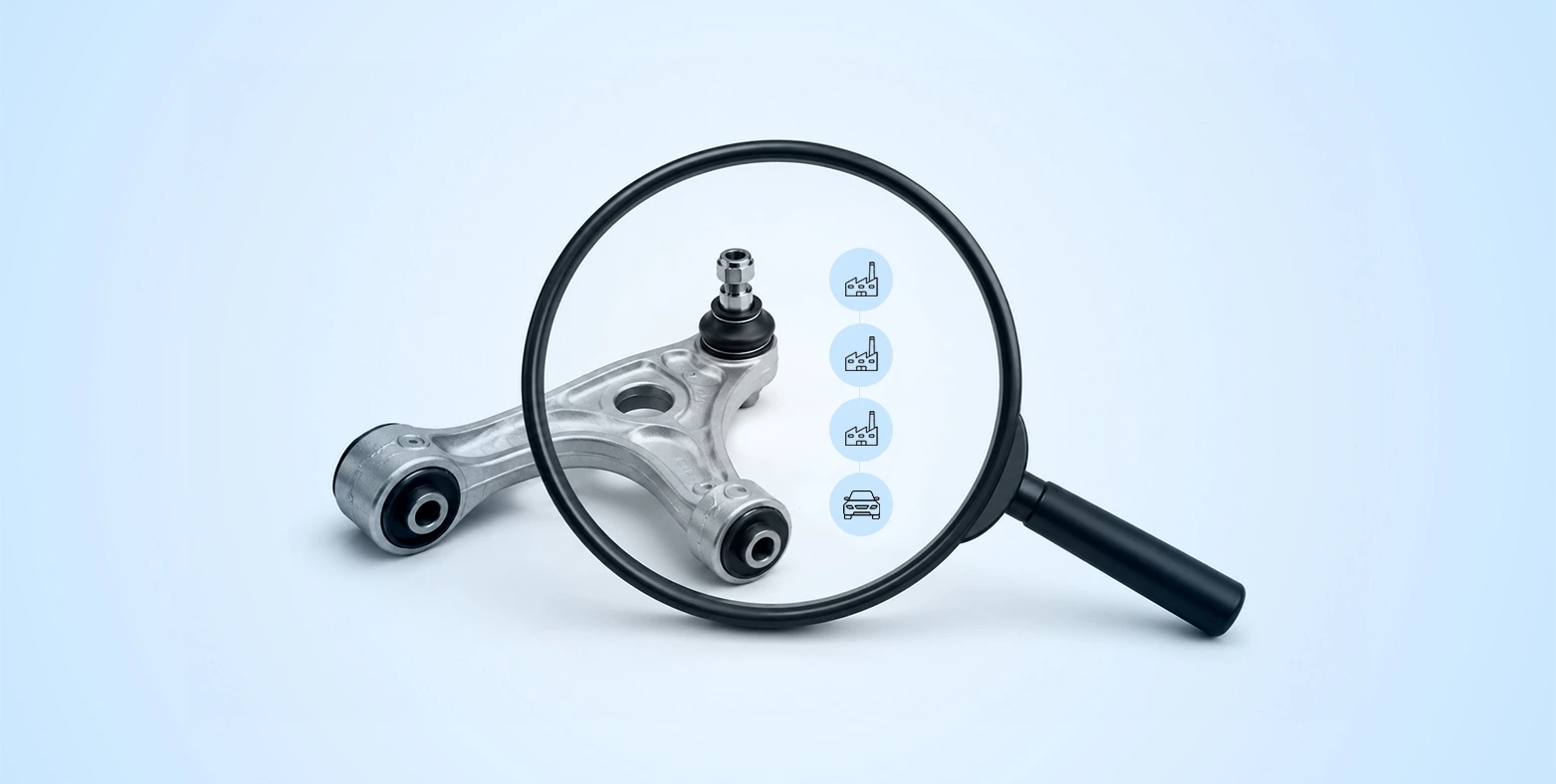
The EU Battery Regulation never mentions Tier 1, Tier 2, or Tier 3 suppliers. It only names one party: the OEM or battery manufacturer, and puts the entire legal duty on them. Under the EU Battery Regulation (2023/1542), that party has to publish the battery passport (Article 77) and run supply chain due diligence (Chapter VII, Articles 48 to 52). Nothing in the law obliges a supplier to hand over data. What obliges them is the contract, because that's how the OEM's legal duty actually gets fulfilled. What each tier is asked for simply depends on where it sits in that chain.
What follows is the breakdown by tier: what an OEM has to publish, what gets pushed down to Tier 1 through Tier 3, and where a supplier's own responsibility actually starts and stops.
They describe how far a supplier sits from the vehicle or battery manufacturer, not how important the supplier is.
An OEM (Original Equipment Manufacturer) asks a Tier 1 supplier for a component's carbon footprint. A Tier 1 buyer asks a Tier 2 processor for the recycled cobalt percentage in a cell, along with how it was calculated. A Tier 2 processor asks its Tier 3 supplier where the nickel was mined.
None of these requests come from a regulator. They come from the buyer, because the buyer is the one who has to prove compliance under the Battery Regulation, and it can't do that without the supplier's numbers upstream. That's the whole mechanism in one sentence: one legal duty sits with the OEM, and it moves down the chain as a set of contract terms, not as a separate law aimed at suppliers (Article 49(1)(d) and (e)).
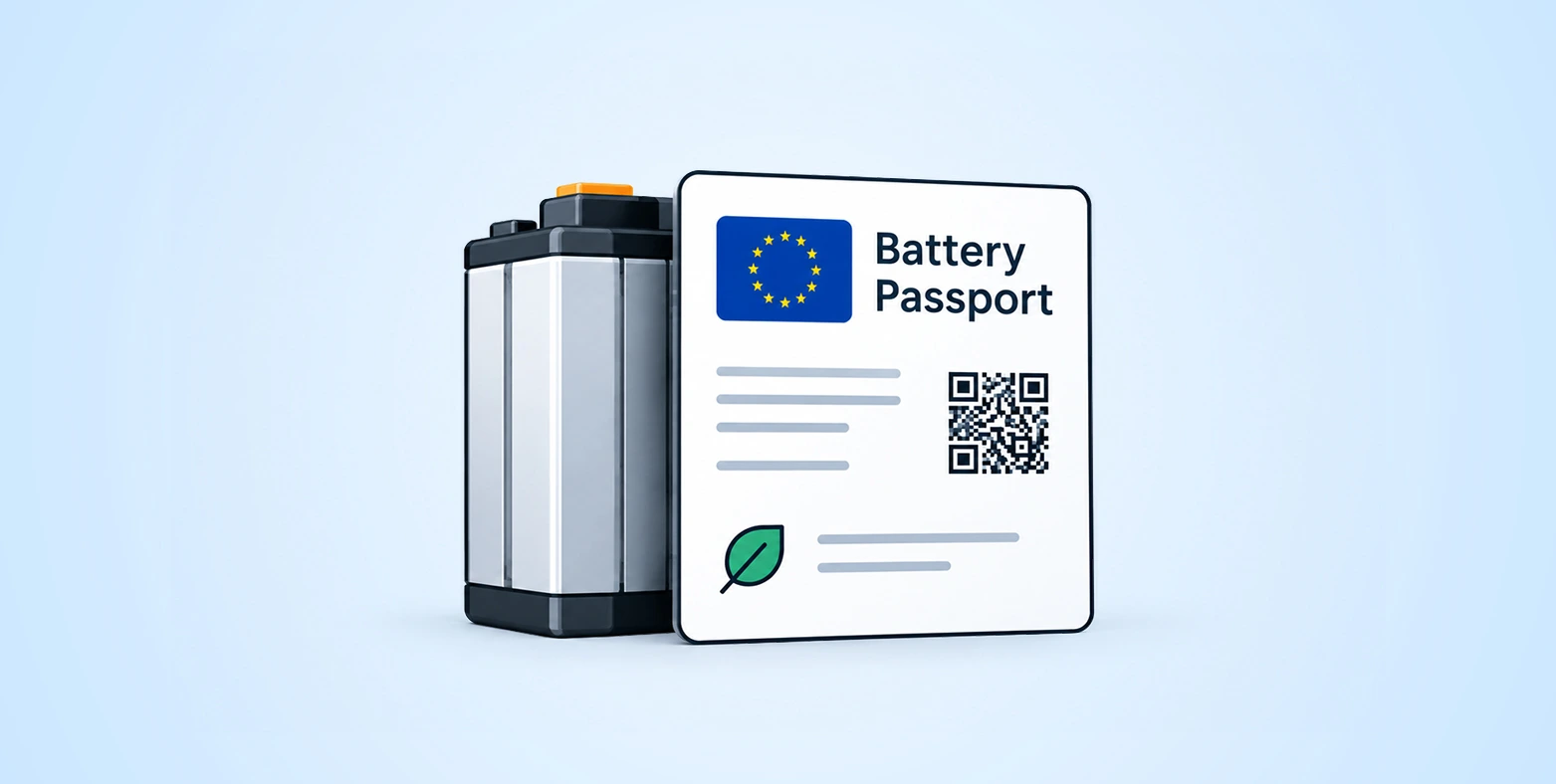
For the OEM-level obligations behind these requests, our earlier piece on automotive traceability covers what goes into the Battery Passport itself and how its access-control tiers work.
Annex XIII sets out exactly what goes into the battery passport, split into four access levels.
Point 1: publicly accessible information
Sustainability
Performance and durability
Compliance and end of life
Point 2: accessible only to persons with a legitimate interest and the Commission
Point 3: accessible only to notified bodies, market surveillance authorities, and the Commission
Point 4: accessible only to persons with a legitimate interest, specific to an individual battery
The Regulation doesn't assign passport data to specific supplier tiers; Annex XIII only says what must be in the passport, not who provides each part. What follows is how that responsibility typically works out in practice, based on which tier actually holds each piece of information, not a rule set out in the law itself. This mapping draws on the Global Battery Alliance's chain of custody model, which tracks cobalt, natural graphite, lithium, and nickel from raw material production or recycling, through refining, to active material production (GBA, Section 2.1, p. 9, Feb 2026).
Annex XIII lists what has to be in the passport. Here's how that might break down in practice.
Tier 1 usually hands over the carbon footprint number for their part of the battery, a summary of material composition and recycled content that Tier 2 already gave them, and the dismantling instructions for the pack itself, since they're the ones who built it and know how it comes apart. For example, a pack assembler would be the one who can say "here's how many bolts hold this together and what tool removes them," because nobody further up or down the chain has that information.
Tier 2 usually provides the material composition and recycled content figures for whatever they actually process, the cathode material, the anode material, or the electrolyte, along with origin paperwork they've collected from Tier 3. For example, a cathode material processor would report the exact chemical makeup of what they produced and pass along the mine-of-origin certificate their own supplier gave them.
Tier 3 usually provides where the raw material actually came from and the paper trail proving it, since that's the one thing only they know. For example, a cobalt mining operation would confirm the mine's location and hand over export records showing the material's journey from the ground to the first buyer. What Tier 3 doesn't do is tell anyone how the battery pack disassembles or what's in the electrolyte mix, since that's knowledge that only exists further down the chain.
The OEM keeps a few things entirely to itself: the finished battery's performance numbers (voltage, capacity, lifespan), the labelling and conformity paperwork, the compliance test reports, and everything about how the battery is actually used after it leaves the factory. None of that comes from a supplier, because none of it exists until the battery is built and out in the world.
Who is legally responsible for the EU battery passport?
The economic operator that places the battery on the EU market or puts it into service, typically the OEM or battery manufacturer, under Article 77 of Regulation (EU) 2023/1542.
Do Tier 1, Tier 2, and Tier 3 suppliers have direct legal obligations under the Battery Regulation?
No. The passport obligation (Article 77) and the due diligence obligation (Chapter VII) apply only to the economic operator placing the battery on the market. Suppliers receive data requests by contract, not by direct regulatory duty.
When does the EU battery passport become mandatory?
From 18 February 2027, for LMT batteries, industrial batteries above 2 kWh, and electric vehicle batteries.
What raw materials fall under Annex X due diligence?
Cobalt, natural graphite, lithium, and nickel.
Sources
1.Regulation (EU) 2023/1542: EU Battery Regulation
2.Global Battery Alliance, GBA Battery Passport: EU Battery Regulation whitepaper (Feb 2026)
3.European Commission DG GROW Webinar, "The Digital Product Passport: Implications and Practical Guidance for the Battery Industry," 27 May 2026
.svg)

.svg)


.svg)
.svg)



%202026_1310.webp)