
.svg)

The European Commission has published version 2.0 of its guidance mapping all 71 Annex XIII data points for the digital Battery Passport under Regulation (EU) 2023/1542. It sets out which fields are mandatory, optional, conditional, or excluded from February 2027, separately for EV, LMT and industrial batteries above 2 kWh.
Mandatory data points by category:
LMT carries the highest count, not EV. The reason: five state-of-health fields are mandatory for LMT and excluded entirely for EV (more on this below).
The guidance creates no new legal requirement; it clarifies obligations already set out in Regulation (EU) 2023/1542, ahead of the passport's 18 February 2027 deadline. What follows is a field-level reference to check against your own data-collection plan. For the wider timeline, see our Battery Passport deadlines guide.
None of these is required in the passport as of February 2027, for any category:
Keep all eight in your data schema as pending fields. Several become mandatory once the missing act or date arrives, so don't build a February 2027 pipeline around carbon footprint or due diligence in particular.
These fields don't vary by battery type, so they're the easiest to plan for:
Points 45–50 are the largest block with zero category variation anywhere in the table.
Several fields drop from mandatory to conditional for industrial batteries only:
One field runs the other way: point 33 (capacity threshold for exhaustion) is mandatory for EV only, excluded for LMT and industrial.
A few fields are conditional across all three categories, not just industrial: points 57–58 (round-trip efficiency and fade) and points 68–71 (cycle count, negative events, environmental conditions, state of charge).
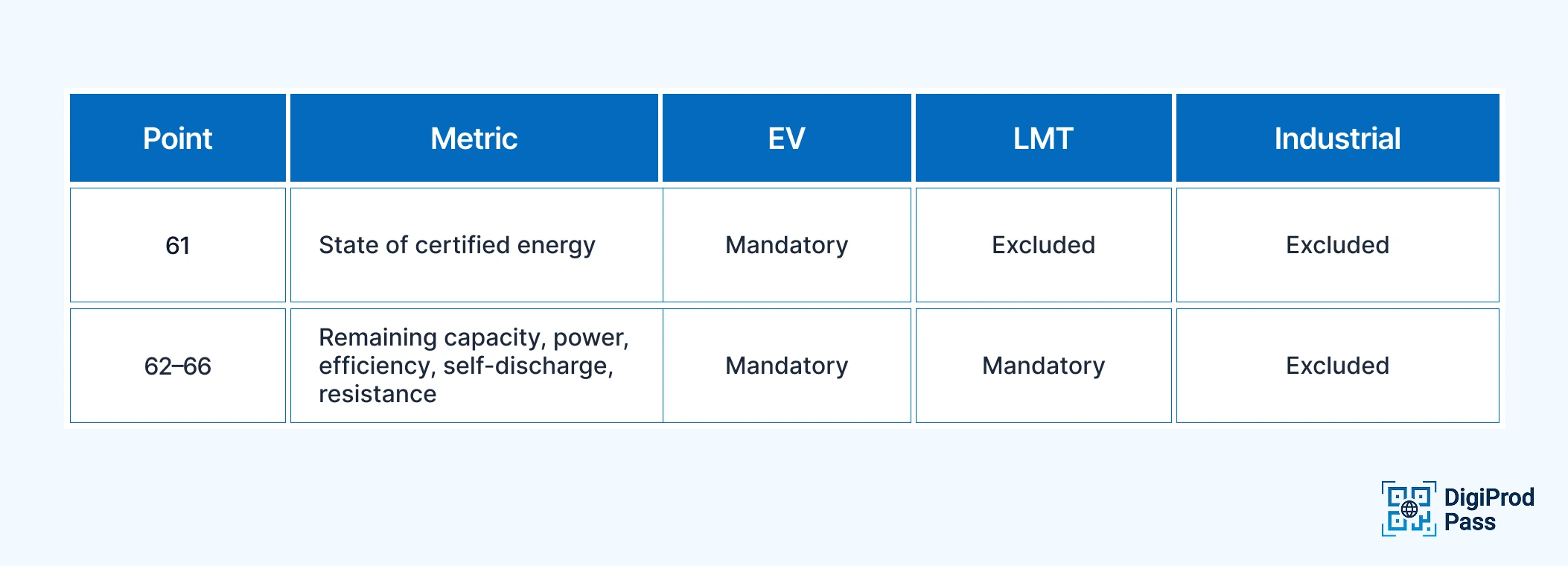
EV reports state of health through one figure. LMT reports it through five. Industrial reports whichever of those five apply to that battery. This split is why LMT's mandatory count (50) beats EV's (47).
DigiProd Pass works with battery manufacturers and importers on exactly this kind of data-collection audit: mapping which of the 71 points are already held, where the gaps sit by category, and how to bring supplier data into a form the passport can actually use before February 2027.
Is this guidance legally binding?
No. The Commission states it does not represent its official position and creates no new legal requirement.
Do all 71 data points apply to every battery?
No. Each point is marked mandatory, optional, conditional, or excluded, separately for EV, LMT and industrial batteries.
Why does LMT have more mandatory fields than EV?
Points 62–66 (five state-of-health metrics) are mandatory for LMT and excluded for EV, a gap the two EV-specific fields elsewhere don't offset.
Are carbon footprint and due diligence data required at launch?
No. Carbon footprint (points 17–18) has no set reporting format yet; due diligence documentation (point 19) is required from August 2027, not February.
When does the Battery Passport become mandatory?
18 February 2027, for EV batteries, LMT batteries, and industrial batteries above 2 kWh, under Article 77(1) of Regulation (EU) 2023/1542.
1.Regulation (EU) 2023/1542 (Batteries Regulation), Annex VI and Annex XIII: eur-lex.europa.eu
2.European Commission, Directorate-General for Internal Market, Industry, Entrepreneurship and SMEs, Guidance Document: Digital Batteries Passport – data points by category, Version 2.0, 15 August 2026 (Ref. Ares(2026)7968977)
.svg)

.svg)

%202026_1310.webp)


.svg)
.svg)