.svg)


Zero-Knowledge Proofs (ZKPs) build trust in blockchain by enabling verification of transactions without exposing the underlying data. ZKPs reduce the need for intermediaries or trusting blindly by providing a mathematically reliable method that confirms the data's authenticity. Thus, both security and confidentiality for the parties involved are ensured.
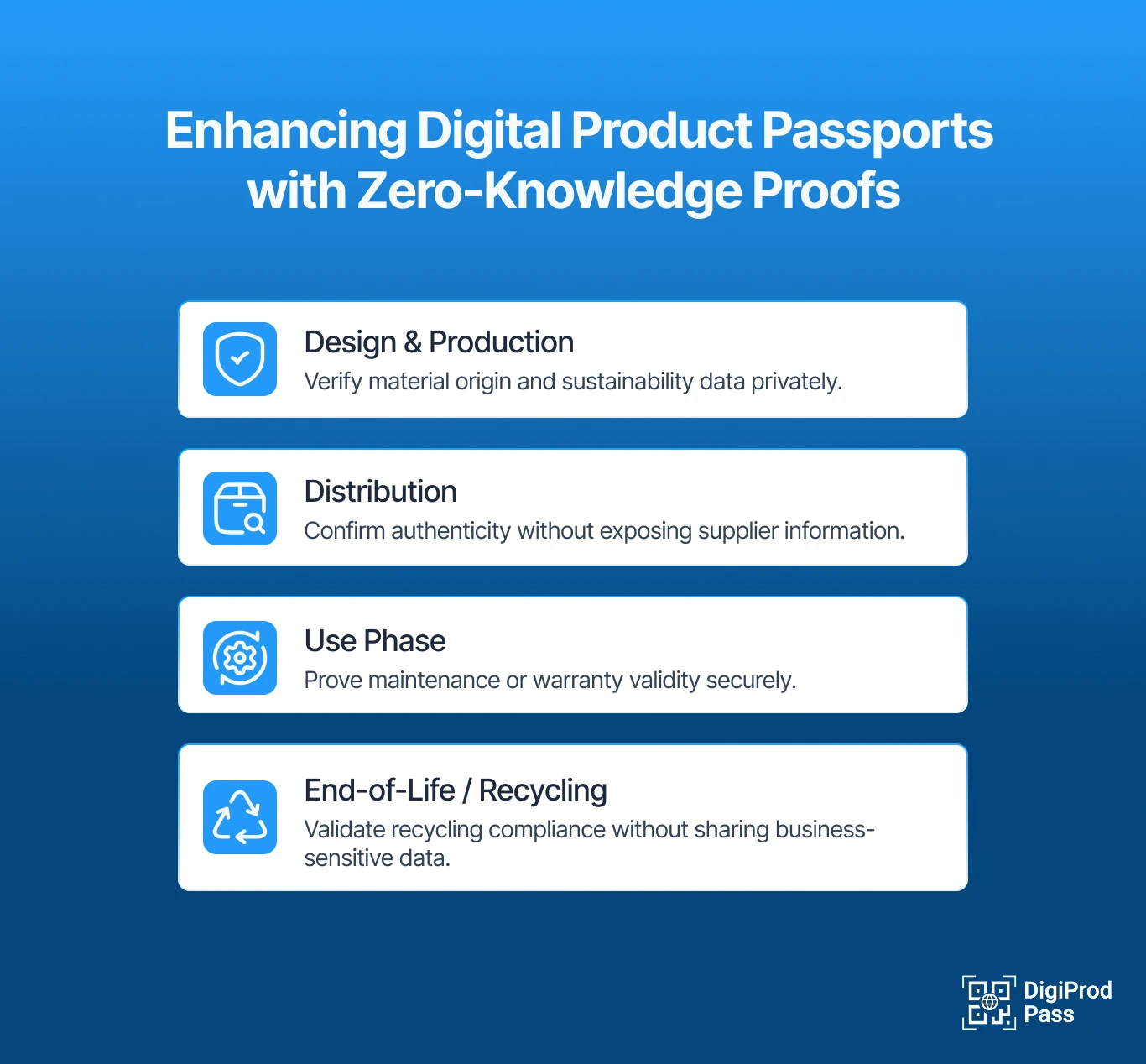
This verification process strengthens confidence in blockchain networks and allows enterprises to participate in digital ecosystems securely, such as when issuing a Digital Product Passport (DPP) to verify product authenticity without exposing sensitive details. With the ability to maintain privacy while proving authenticity, ZKPs have become a critical tool for organisations seeking trusted, compliant, and efficient blockchain operations.
The Paradox of Trust in Blockchain is Resolved
Trustless verification, promised by blockchain technology, allows transactions that should not rely on a specific or centralised authority. However, there is a gap in transparency as well, the gap of privacy; the chances of exposing sensitive information or user data. A common challenge for businesses is finding a way to utilise the advantages of blockchain technology without compromising the privacy of their sensitive data.
Zero-Knowledge Proofs resolve the problem; firstly, the prover demonstrates possession of specific information or the correctness of the statement. And then the verifier challenges the proof without accessing the data underlying it, the prover then responds in such a way that convinces the verifier about the truthfulness of the statement.
Finally, the verifiers, without leaning on any sensitive details, confirm the validity. ZKPs confirms verifications and assurance, besides preserving full confidentiality. Thus, ZKPs become critical tools for enterprise blockchain applications.
Zero-Knowledge Proofs provide substantial business advantages beyond their cryptographic Intricacy. With ZKP technologies, companies can securely verify compliance, authenticate identities, and exchange data without disclosing any confidential information. As it reduces the risk of data exposure while ensuring verifiable integrity and strikes a balance between discretion and transparency, institutional trust gets stronger.
Like a financial auditor that confirms solvency but does not need to access users’ account details, ZKPs also establish validation without requiring data disclosure. This system is vital for businesses to compete in a regulation-conscious and data-driven digital economy.
Zero-Knowledge Proofs can operate in interactive or non-interactive modes. Interactive proofs involve multiple challenge-response rounds between the prover and verifier, providing iterative verification that reduces the chance of error. Non-interactive proofs (NIZKs) allow a single, verifiable proof using cryptographic hashes, making them ideal for asynchronous enterprise blockchain networks where speed and storage efficiency are critical.
When comparing zk-SNARKs and zk-STARKs, there are key trade-offs:
Enterprise Applications (Examples)
These technical choices and applications ensure that enterprise blockchain solutions remain secure, privacy-preserving, and compliant, translating complex cryptography into actionable business trust.
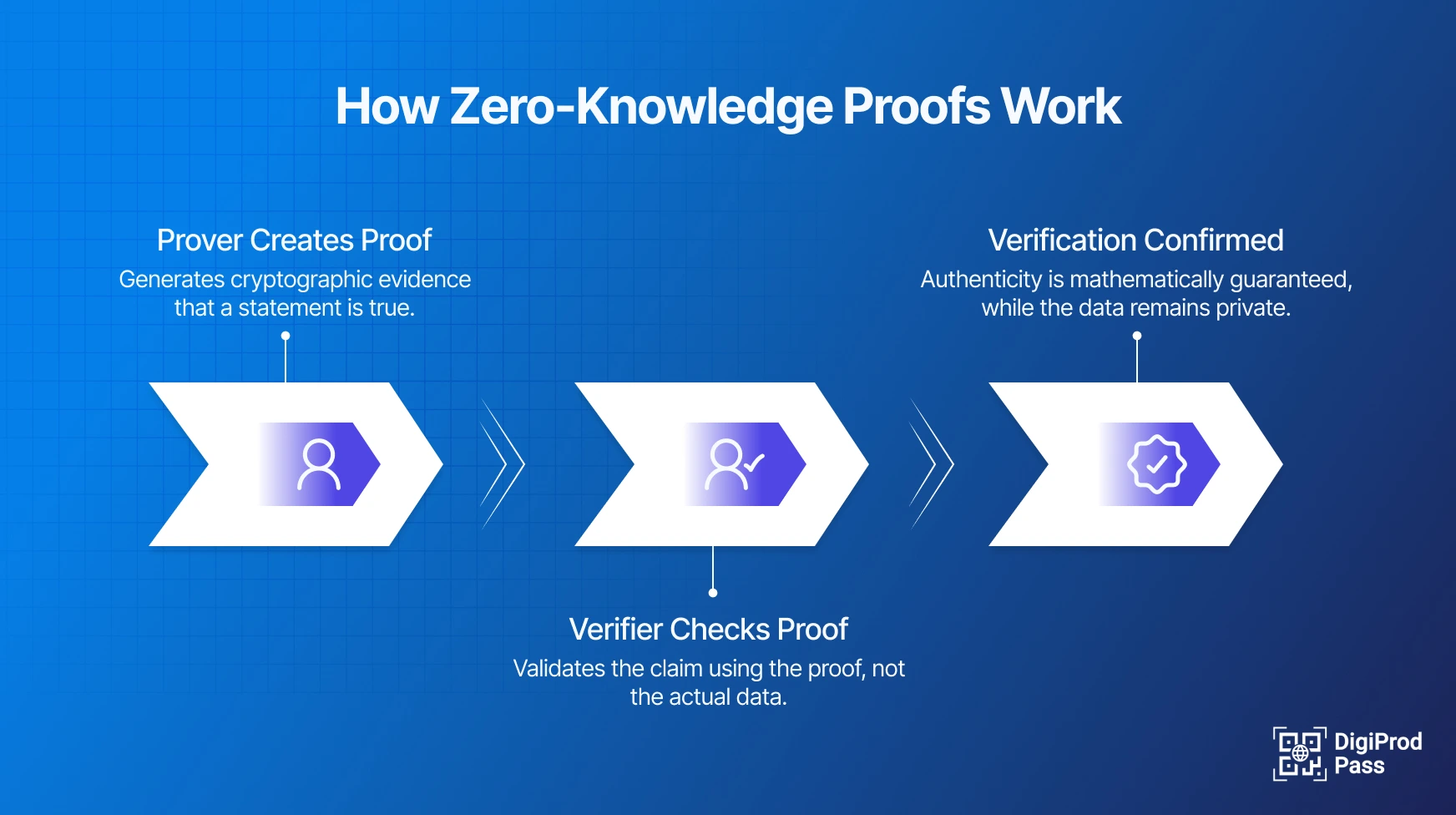
Although the concept of Zero-Knowledge Proofs appears somewhat abstract, the underlying mathematical framework is quite complex. Mainly, a ZKP would allow one party to provide the proof of their statement without disclosing data or information behind it. Instead of data sharing, the system is based on algorithms that provide verifiable assurance.
Sounds complex? It is, but the businesses cannot deny how ZKPs can enhance their competitiveness.
zk-SNARKs(Zero-Knowledge Succinct Non-Interactive Arguments of Knowledge) and zk-STARKs (Zero-Knowledge Scalable Transparent Arguments of Knowledge) are two of the most widely adopted ZKP approaches.
Practically, these proofs act like digital seals of authenticity. Here, an identity verification, any transaction, or compliance check can be validated with complete confidence without compromising the privacy of the underlying data. This capability allows enterprises to participate in blockchain networks without compromising sensitive information, offering both security and operational flexibility.
Zero-Knowledge Proofs (ZKPs) are a significant matter for companies dealing with tough data privacy rules like GDPR, CCPA, and new blockchain stuff like MiCA. By integrating ZKPs into their data policy, organisations can ensure regulatory alignment while maintaining full confidentiality over sensitive information. This makes dealing with auditors and regulators way smoother.
Picture a bank, for instance, that can confirm a transaction is totally compliant without having to spill the customer's personal details. Or, think of a supply chain company that can verify a product was ethically sourced without sharing its confidential list of suppliers. This selective sharing capability from ZKPs seriously cuts down on legal risk while keeping core business secrets safe.
ZKPs change compliance from simply a requirement into a real competitive edge. Companies can jump into partnerships confidently, knowing they're ticking all the legal boxes while simultaneously keeping their valuable data locked down. This level of secure, verifiable disclosure is unattainable through conventional methodologies.
Zero-Knowledge Proofs (ZKPs) fundamentally transform trust on the blockchain by enabling verification of transactions without revealing sensitive data. By providing mathematically sound proofs, ZKPs eliminate the need for intermediaries or blind trust, allowing global manufacturers to operate securely and efficiently in digital ecosystems.
This balance of privacy, transparency, and verifiable authenticity enhances confidence in blockchain networks, ensures regulatory compliance, and protects critical business information. For organisations seeking secure, reliable, and privacy-preserving blockchain solutions, ZKPs have become an indispensable tool.
Sources
https://finance.ec.europa.eu/digital-finance/crypto-assets_en
https://z.cash/learn/what-are-zk-snarks/
https://cybersecurity.springeropen.com/articles/10.1186/s42400-024-00215-x
.svg)

.svg)

%202026_1310.webp)

.svg)
.svg)