


Can your batteries give you a competitive edge? Under the new EU Battery Regulation, sustainability is no longer just a "corporate value"—it is a mandatory requirement for market access. By tracking recycled lithium, cobalt, nickel, and lead, companies do more than meet legal quotas; they secure their supply chains against global volatility and strengthen their reputation in a circular economy.
The regulation sets strict recycled content targets for EV and industrial batteries (specifically those > 2 kWh). However, for 2026 and beyond, this must be viewed alongside the Critical Raw Materials Act (CRMA), which mandates that $25\%$ of the EU’s strategic raw material consumption must come from recycling by 2030.
Most companies are focused on the initial 2031 targets. However, the regulation includes a "ratchet mechanism" that significantly increases requirements just five years later. To be sustainable, your sourcing strategy must account for these jumps now.
Manufacturers must prepare for a "two-wave" jump in requirements. While the 2031 targets are the baseline, the 2036 targets represent a significant tightening of the circular economy loop.
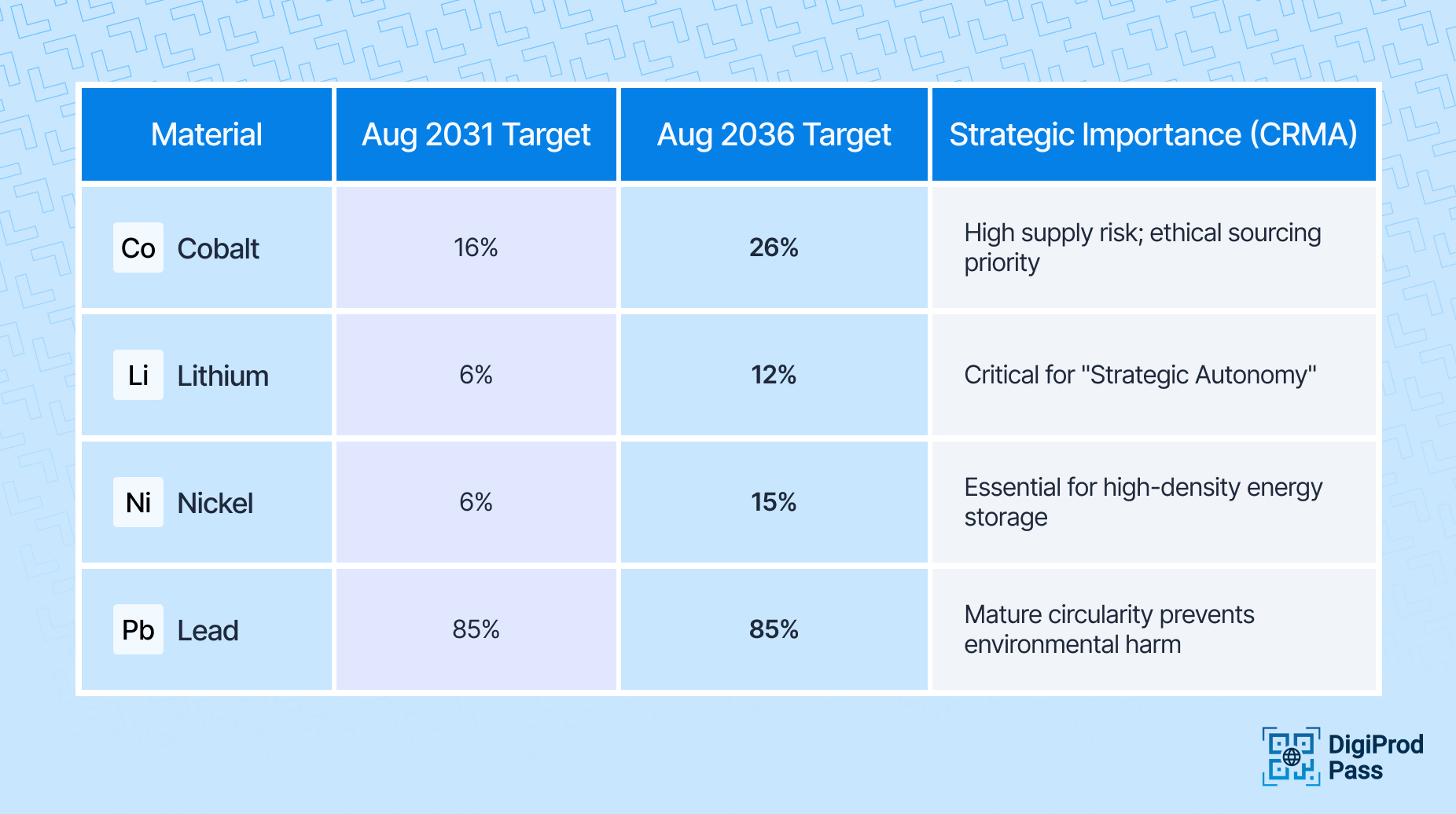
Mature circularity prevents environmental harm.
The Critical Raw Materials Act (CRMA), which entered into full force in 2024, identifies 34 critical materials—17 of which are "strategic." For battery manufacturers, this means:
The most stringent rules—including the Digital Battery Passport—apply primarily to rechargeable industrial and EV batteries with a capacity > 2 kWh. If you produce smaller power packs, your timeline for LMT (Light Means of Transport) batteries is slightly different, with recycled content disclosure starting in 2033.
While originally set for 2025, the enforcement of mandatory Due Diligence has been shifted to August 18, 2027, following the EU's 2025 regulatory simplification. You are required to identify and mitigate social and environmental risks in your supply chains for cobalt, lithium, nickel, and natural graphite
Recycled content isn't just a circularity metric; it’s a carbon lever. Starting in February 2025, EV batteries must declare their lifecycle carbon footprint. Using recycled materials is the fastest way to stay below the "Maximum Carbon Thresholds" that the EU will enforce by 2028.
The Digital Battery Passport (DBP) is the mandatory "digital twin" of your product. By February 18, 2027, every in-scope battery must carry a QR code linking to its specific lifecycle data.
How the Digital Battery Passport secures your supply chain:
Managing global supply chain data manually is a recipe for audit failure. DigiProd Pass is a blockchain-backed platform designed to simplify reporting under the EU Battery Regulation, ESPR, and CSRD.
Our work on projects like DigiBat Pass and WATT EV demonstrates that Digital Battery Passports not only ensure compliance but also build the trust necessary to win over OEMs, fleet operators, and energy providers.
Don't wait for the 2027 deadline to find the gaps in your data.
Check out how DigiProd Pass automates your recycled content reporting and secures your access to the EU market.
Q1: What does the EU battery regulation say about recycled materials?
The regulation requires tracking and reporting recycled lithium, cobalt, nickel, and lead for all batteries sold in the EU, ensuring full lifecycle transparency.
Q2: Why is tracking recycled lithium, cobalt, nickel, and lead important?
It reduces reliance on virgin raw materials, supports sustainable sourcing, prevents environmental harm, and strengthens circular economy practices.
Q3: Which batteries are affected by these rules?
All industrial, automotive, and energy storage batteries placed on the EU market must comply, regardless of size or application.
Q4: How do companies track recycled content?
Through structured documentation, supplier declarations, and digital tools like the Digital Battery Passport, which ensures traceability from sourcing to end-of-life.
Q5: What are the benefits of compliance?
Companies demonstrate sustainability, regulatory compliance, and transparency while reducing raw material costs and building trust with OEMs, fleet operators, and energy providers.
Sources
Regulation (EU) 2023/1542 (Full Text)
Digital Product Passport (ESPR) Framework
JRC Technical Guidelines on Recycled Content
Global Battery Alliance DBP Pilot Projects
.svg)

.svg)


.svg)
.svg)




%202026_1310.webp)