


By 18 February 2027, every industrial battery ($>2$ kWh) and EV battery sold in the EU must carry a QR code linked to a Digital Battery Passport (DBP).
For manufacturers, this requirement often triggers a major concern: “Will our competitors be able to scan a battery and see our proprietary chemical recipes or supplier lists?”
The short answer is no. The EU Battery Regulation (2023/1542) does not demand total transparency; it demands tiered transparency (role-based access control). The system is designed to protect Intellectual Property (IP) while providing essential data to the right people. Here is exactly what data will be visible to the public versus what stays behind a secure firewall.
The QR code does not expose a random webpage; it resolves to a Unique Battery Identifier that links all passport data to a specific battery model or serial number. This identifier enables traceability across manufacturing, ownership changes, repurposing, and end-of-life treatment, while still enforcing strict access control over who can view which data fields.
The information accessible to the general public (consumers and end-users) is limited to "Nutrition Label" style data. This layer focuses on safety, sustainability, and basic identification.
Publicly Accessible Information Includes:
The EU recognises that certain data is too sensitive for the public but essential for the circular economy. This information is only accessible to "Persons with a Legitimate Interest," such as independent repairers, second-life operators, and recyclers.
Access to this layer is granted only after verification of a legitimate professional role, such as certification as a recycler, repairer, or second-life operator. This ensures that sensitive technical data is shared strictly on a need-to-know basis, as required for safe handling and circular economy operations.
Restricted Data (Role-Based) Includes:
The most sensitive information, your "secret sauce", is never shared with the market. Only Market Surveillance Authorities and Notified Bodies can access this layer to verify compliance.
Confidential Data Includes:
It is important to distinguish between Static data (the same for all batteries of one model) and Dynamic data (unique to one specific battery serial number).
Interoperability & Machine-Readable Access
The Battery Passport data must be made available in structured, machine-readable formats to ensure interoperability across the EU ecosystem. This enables regulators, recyclers, and authorised service providers to access consistent data via standardised interfaces, without duplicating records or fragmenting compliance systems.
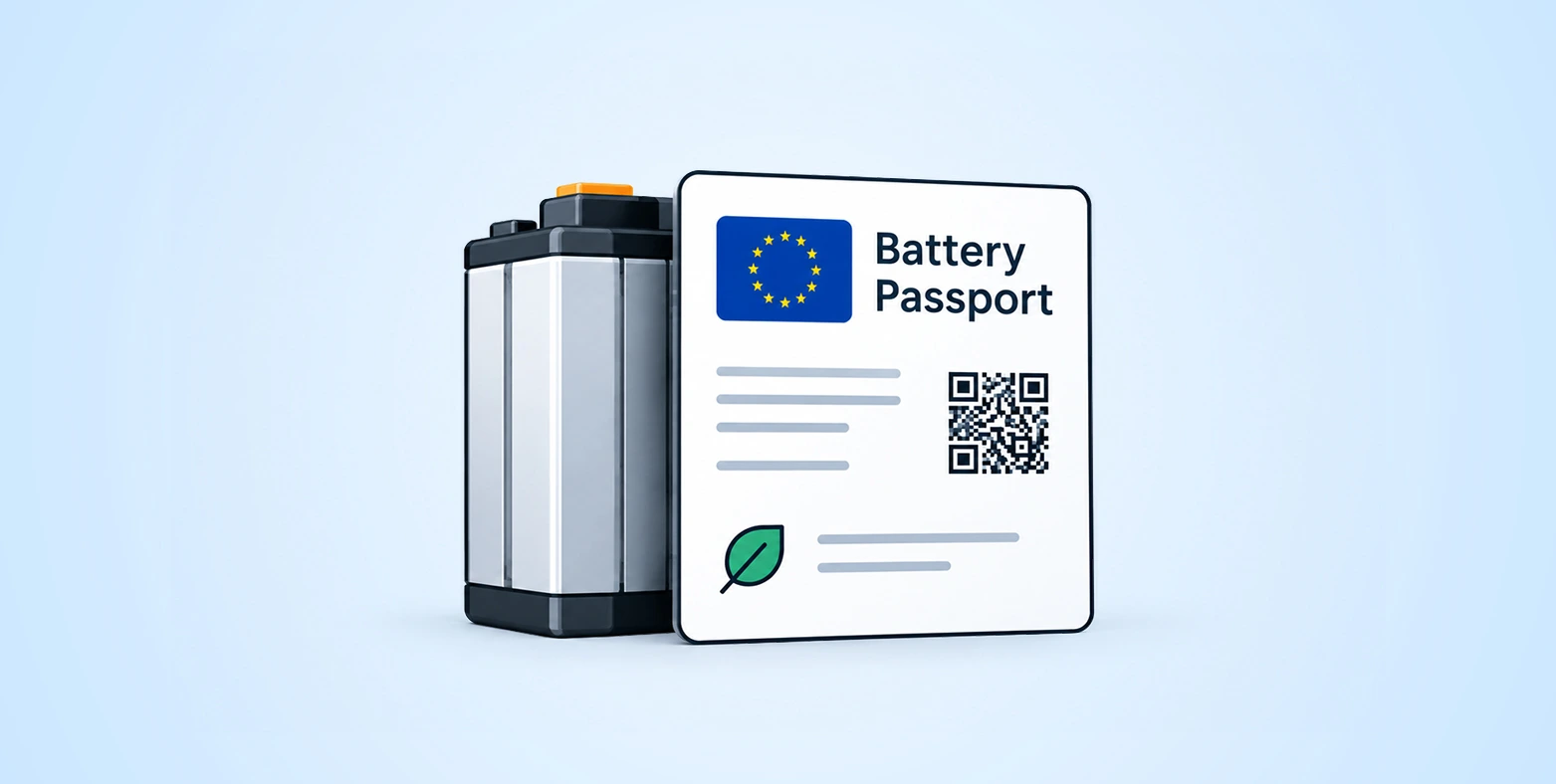
A Digital Battery Passport is a secure digital record that stores and shares essential information about a battery’s sustainability, technical specifications, and lifecycle. Mandated by EU Regulation 2023/1542, it provides transparent data on carbon footprint, recycled content, and state of health to regulators, recyclers, and consumers via a physical QR code.
Annex XIII of the EU Battery Regulation defines a structured set of sustainability, technical, and circular-economy data fields that must be accessible through the Battery Passport, with visibility determined by user role:
Implementing a QR code doesn't mean giving away your secrets. It means using a platform that supports Role-Based Access Control (RBAC).
When a user scans a DigiProd Pass QR code, our system automatically detects their authorisation level. A consumer sees the sustainability stats, while a certified recycler sees the dismantling guide and your proprietary manufacturing data remains locked and encrypted for regulators only.
Is your data strategy ready for the 2027 deadline?
Or would you like to see how we help you manage tiered access and protect your IP?
Yes. When a battery is repurposed, remanufactured, or undergoes "Second Life" processing (e.g., an EV battery moved to stationary grid storage), it is legally considered a new product. The operator responsible for the repurposing must generate a new Digital Battery Passport and a new QR code to reflect the battery's altered state and new expected service life.
Dynamic data, such as State of Health (SOH) and cycle coun,t must be updated whenever there is a material change, such as refurbishment, repurposing, ownership transfer, or significant maintenance. Periodic updates are expected to ensure accuracy throughout the battery’s lifecycle.
The Digital Product Passport (DPP) is a broad EU framework for all consumer goods (textiles, electronics, etc.). The Battery Passport is a specific, high-intensity pilot of this system. It requires much deeper technical disclosures, such as specific carbon footprint performance classes and raw material sourcing "due diligence" that are not yet required for standard DPPs.
Yes, indirectly. If you cannot get primary data from your suppliers, you must use EU-approved secondary datasets. These averages are intentionally conservative (higher) than actual emissions. This can push your battery into a lower Performance Class (e.g., Class D instead of Class B), making your product less competitive in green procurement tenders.
.svg)

.svg)


.svg)
.svg)



%202026_1310.webp)