
.svg)


ESPR, the European Circular Economy regulation, is setting clear expectations for product transparency, evidence, and accountability. Meeting those expectations is not primarily a technology challenge, it is a data coordination challenge across complex value chains. Digital Product Passports succeed only when organisations collaborate to align data ownership, standards, and verification, transforming fragmented information into credible, audit-ready compliance.
This article demonstrates why effective, end-to-end supply chain collaboration is essential for the successful implementation of Digital Product Passports.
A Digital Product Passport is not a single dataset created at one point in time. It is a living record that accumulates information as a product moves through its lifecycle. To be meaningful, compliant, and usable, a DPP must bring together multiple categories of data — most of which are owned by different actors across the value chain.
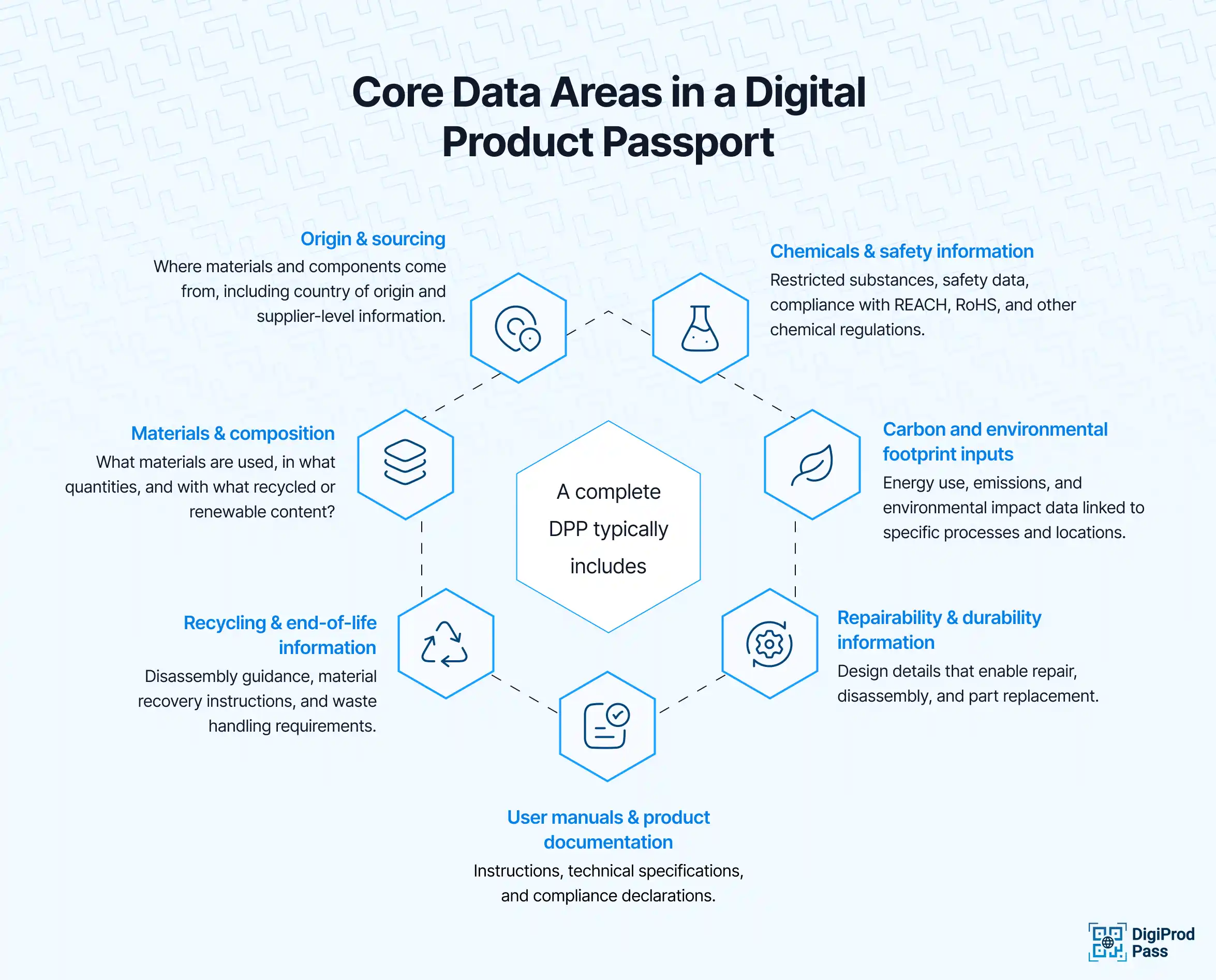
No single organisation naturally holds all of this information. Data from different sources needs to be included to make a DPP work. To gain a deep understanding of Digital Product Passports (DPP), a detailed resource outlining the information they provide is available here.
Digital Product Passports depend on distributed data ownership. Each actor contributes a specific part of the product story:
Each dataset is valid only when it comes from the party responsible for that stage.
Digital Product Passports are built on distributed data ownership. Because required information is created and held at different stages of the value chain, DPP data is fragmented by design. As a result, collaboration is not an optional enhancement — it is a structural requirement.
This is why collaborative pilot programmes play such a critical role in DPP implementation. They provide a controlled environment where multiple value-chain actors can work together to operationalise DPP requirements before full regulatory enforcement.
Through collaborative pilots, companies can:
In practice, it is these pilot programmes that transform Digital Product Passports from compliance concepts on paper into functioning, real-world systems.
Even the best-intentioned Digital Product Passport initiatives can fail if the underlying data is fragmented. In most supply chains, information exists in siloed systems — ERP(Enterprise Resource Planning), PLM (Product Lifecycle Management) platforms, supplier portals, or even simple spreadsheets. Add inconsistent naming conventions, units, or file formats, and the challenge multiplies.
Other common issues include:
When data is scattered, inconsistent, or incomplete, the consequences are serious:
The solution is collaboration combined with a unified digital approach, ensuring all actors can contribute, verify, and maintain accurate product information.
If data fragmentation is the problem, structured collaboration is the solution. But collaboration is more than meetings or emails; it is a systematic, governance-driven approach that ensures every actor in the value chain can contribute, verify, and maintain accurate Digital Product Passport information.
Key elements of effective collaboration include:
When these elements are in place, collaboration is no longer optional — it becomes the operational backbone of reliable Digital Product Passports. Pilot programmes, in particular, provide the environment to test, refine, and embed these practices before scaling across the full supply chain.
Collaboration alone is not enough — it must be supported by technology that makes data sharing practical, reliable, and scalable across the value chain. The right tools ensure that multiple actors can contribute, verify, and maintain Digital Product Passport information efficiently.
Key technological enablers include:
By combining structured collaboration with these technological enablers, companies can move from fragmented, error-prone processes to trustworthy, scalable Digital Product Passports — creating value for regulators, brands, and consumers alike.
Starting a full-scale Digital Product Passport initiative across your entire value chain can feel overwhelming. The key is to begin small, structured, and measurable. A pilot approach allows you to test processes, validate data, and refine collaboration practices before scaling.
Step 1: Launch a Pilot
Step 2: Define a Minimum Viable Passport (MVP)
Step 3: Standardise Supplier Data Requests
Step 4: Set Clear KPIs
By following this structured playbook, companies can turn collaboration into measurable outcomes, build trust across the value chain, and gradually scale Digital Product Passports from a pilot to enterprise-wide adoption.
Even well-intentioned Digital Product Passport initiatives can stumble if key lessons from collaboration and pilots are ignored. Awareness of common pitfalls — and proactive strategies to address them — is essential for success.
1. “Tech-First, People-Last” Implementations
2. No Single Source of Truth
3. Over-Collecting Data Too Early
4. Unclear Ownership Across Teams
By anticipating these challenges and embedding collaboration, pilots, and structured governance from the start, companies can avoid common missteps and ensure their Digital Product Passports are reliable, complete, and trusted.
Imagine a brand working with three key suppliers on a pilot Digital Product Passport:
The results are immediate and tangible:
This scenario illustrates how focused collaboration, even on a small scale, can unlock measurable benefits and demonstrate the value of Digital Product Passports before full-scale rollout.
Digital Product Passports are moving from concept to reality, and DigiProd Pass provides tangible evidence that partnerships and ecosystem collaboration are the key drivers of progress.
Cross-Border Pilot Collaboration: Furniture Sector
DigiProd Pass launched a strategic pilot partnership with Sourcebynet, a global sourcing and supply chain partner supporting furniture brands and manufacturers, engaging teams across Denmark, Vietnam, and Singapore to align data structures and passport formats and demonstrate how Digital Product Passports can function across borders and supply chains. As part of the pilot, selected products will be equipped with DigiProd Pass-powered DPPs and showcased at the Furniture Fair in Shanghai, China, providing a public, hands-on demonstration of DPP technology for industry stakeholders.
Industry & Ecosystem Partnerships: Bangladesh Supply Chain Readiness
DigiProd Pass has formed collaborations and Memorandums of Understanding (MoUs) with BGMEA (Bangladesh Garment Manufacturers and Exporters Association) aimed at preparing local RGM industries for EU compliance requirements. These initiatives illustrate that DPP adoption is not just about software, it requires coordinated work across organisations, suppliers, and local ecosystem partners.
EU Project Collaboration: Circular Plastics & Automotive
DigiProd Pass participates in collaborative initiatives such as EcoPlast and autoMatPass, focusing on closing data gaps to enable traceability, sustainability, and circularity. These projects demonstrate that DPP progress depends on shared innovation and joint problem-solving at the sector level.
Manufacturing Partnerships
DigiProd Pass also collaborates directly with industry players, such as the DFS Group drives DPP adoption in manufacturing contexts. These partnerships show how hands-on collaboration with brands, suppliers, and technology providers can create practical, operational solutions.
Takeaway: Across pilots, industry initiatives, EU projects, and manufacturing partnerships, DigiProd Pass demonstrates that Digital Product Passports succeed when collaboration is structured, cross-functional, and ecosystem-driven.
Digital Product Passports are more than digital forms or compliance documents; they are trust infrastructures that only become meaningful when multiple value-chain actors collaborate. Technology, standards, and governance are essential enablers, but the real impact comes from structured collaboration, pilot programmes, and ecosystem partnerships.
For companies ready to take the next step, the path is clear:
By embracing collaboration as the backbone of DPPs, organisations can turn regulatory requirements into operational advantage, trusted sustainability claims, and circular economy opportunities.
1. Who owns the data in a Digital Product Passport?
Data ownership is distributed across the value chain. Each actor — suppliers, manufacturers, brands, and recyclers — retains responsibility for the information they create, verify, and update. Governance models and pilot programmes clarify these roles to ensure accountability and trust.
2. How do we protect intellectual property (IP)?
DPP systems use access controls, confidentiality agreements, and audit trails to protect sensitive information. Data-sharing agreements define who can see, update, or verify each field, balancing transparency with IP protection.
3. What’s the first step to get started with a DPP?
Start small. Launch a pilot on one product line or supplier tier, define a minimum viable passport (MVP) with essential data fields, and align partners on data responsibilities. Use the pilot to test systems, refine workflows, and build trust before scaling across your full supply chain.
Sources:
European Commission – Ecodesign for Sustainable Products Regulation (ESPR)
CIRPASS – Digital Product Passport Implementation (EU-funded project)
CIRPASS-2 – Digital Product Passport Pilot Programmes
GS1 US – GS1 Digital Link (Identifiers & Data Carriers)
ECHA – Candidate List Substances in Articles (REACH information duties)
.svg)

.svg)



.svg)
.svg)


%202026_1310.webp)