
.svg)

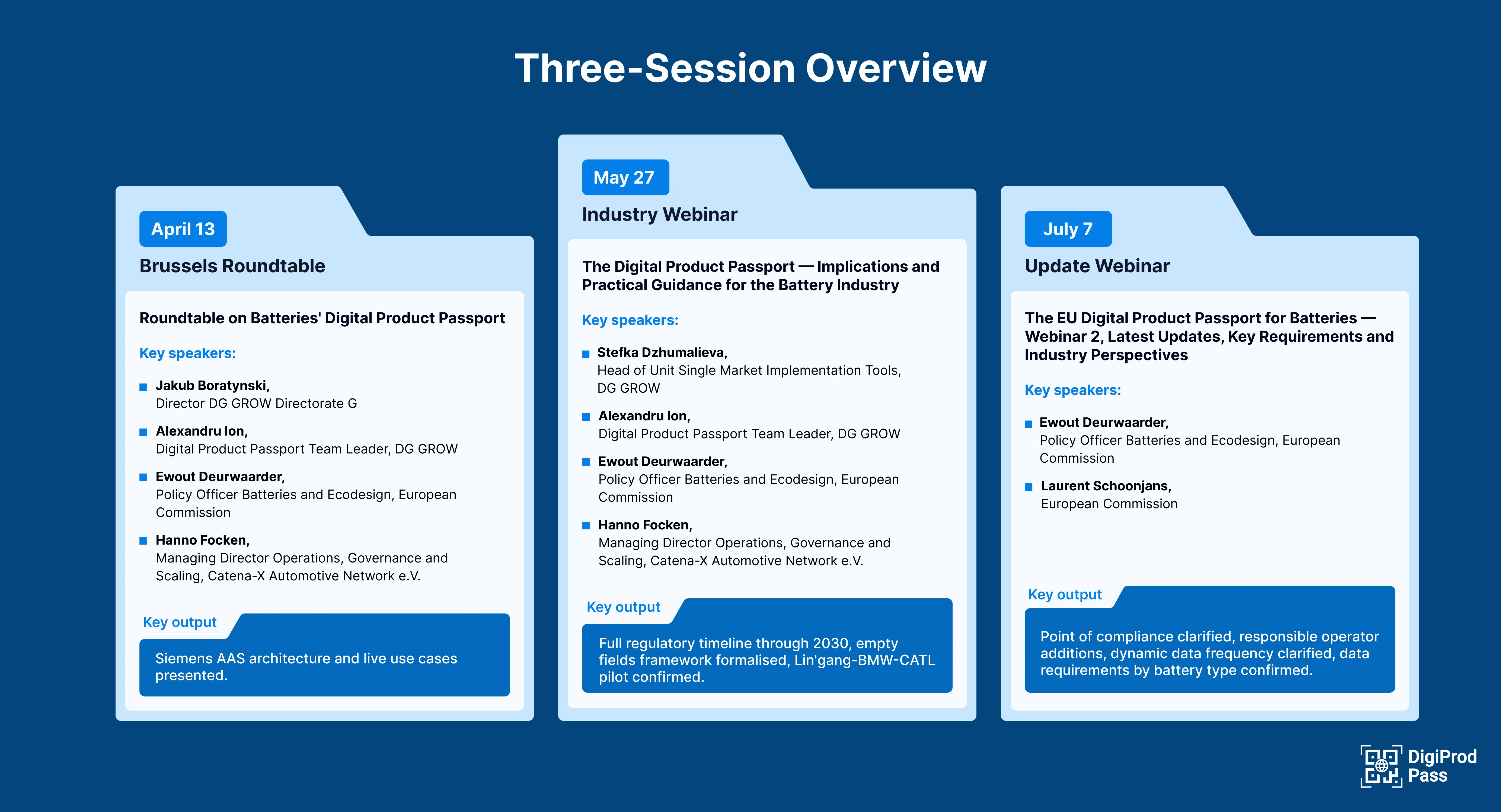
The European Commission's Battery Passport sessions in 2026 provided some clear guidance for the Digital Battery Passport. The April roundtable in Brussels, the May industry webinar and the July update webinar clarified questions on data requirements, responsible operators, access rights, empty fields, point of compliance, cross-border data transfer, technical standardisation and the full regulatory timeline through 2030. This article covers all three session updates under Regulation (EU) 2023/1542. If you are a battery manufacturer, you must stay aligned with the EU Battery Regulation Updates.
Siemens presented two active battery passport use cases. Siemens Mobility is building Digital Battery Passports for rolling stock portfolios with traction batteries. Siemens Digital Industries has developed Digital Product and Battery Passport software for both its own products and for customers, commercially available through SDEX and as a native Xcelerator product.
Siemens also presented the technical architecture: the Asset Administration Shell standard, the DIN DKE SPEC 99100 framework, and the IDTA and Catena-X joint working group. The AAS approach supports the preparation and implementation of regulatory requirements, allows horizontal and vertical delegated acts to be implemented using submodels, and increases interoperability among stakeholders through established IT and industry standards.
An important update regarding access rules was mentioned in this webinar: an implementing act under Article 77(9), targeted for Q4 2026, will define who can see restricted passport data and to what extent they can download, share, publish or re-use it.
Regarding Dynamic data update frequency, the existing Battery Regulation Act 14, Recital 46, specifies daily updates for the State of Health. However, in this webinar, it is clarified that this Recital is not legally binding, and a lower frequency is acceptable where the accuracy of measurement implies no difference with the previous day.
The EU battery passport requires data disclosure. China's Data Security Law and Cybersecurity Law require security assessments for the outbound transfer of what China classifies as Important Data. The battery sector's Important Data catalogue is still under development. At the May webinar, Hanno Focken from Catena-X presented a live result.
The Lin'gang-BMW-CATL pilot is described by Catena-X as the world's first compliant cross-border battery passport data transfer between China and Europe. The Lin'gang Special Area in Shanghai developed a Data Whitelist defining which data fields can leave China. CATL collected product data across 43 static fields and transmitted it to BMW. Around 80 per cent of EU static data requirements were cleared by Chinese law: general information, materials, carbon footprint, circularity and performance. The remaining 20 per cent, detailed composition data and disassembly manuals, were excluded as sensitive. The outcome was included in the China-Germany High-Level Summit outcome list from 26 March 2026. The 20 per cent gap is the live issue; each manufacturer currently needs its own arrangement for that data.
On 7 July 2026, Ewout Deurwaarder and Laurent Schoonjans from the European Commission presented clarifications across six areas:
Point of compliance - When must the battery passport exist? | July 7 webinar — Ewout Deurwaarder, European Commission
The passport must exist, be filled and registered when the battery is placed on the EU market (though dynamic data could be largely empty)
Imported batteries — usually, when they are presented to EU customs and declared for release for the free circulation procedure
Responsibility for the battery passport | July 7 webinar — Ewout Deurwaarder, European Commission
The responsibility for creating the passport and keeping it up to date lies with the economic operator that places the battery on the EU market, normally: EU manufacturer, Importer, or (in the case of direct sales from outside the EU to the end-user) Operator offering the product for sale
Written authorisation — May be given to any other operator to act on its behalf, e.g. service provider, manufacturer (when importing), cell manufacturer, OEM
Carbon footprint, recycled content, due diligence | July 7 webinar — Ewout Deurwaarder, European Commission
Only in the passports of batteries placed in the EU market after the specific requirement starts to apply (to that category of battery)
Only results, no supply chain data — Thus: Carbon footprint declaration · Carbon footprint label · Recycled content figures · Due diligence public report
Carbon footprint timing — At present, there is no indication of timing for carbon footprint possible (once adopted, more than a year to comply)
Access rights, restricted data, authentication | July 7 webinar — Ewout Deurwaarder, European Commission
Implementing the act on access rights — Who can access and what they can do with the data. Stakeholders and Member States consulted on 29 April; feedback received. To be discussed further with Member States. Draft on 'have your say' and for WTO/TBT consultation in the coming months
Authentication is not part of the Commission's mandate. No centralised database, so no centralised system. Certain national registries could help with identification
Frequency of dynamic data - How often must dynamic battery passport data be updated? | July 7 webinar — Ewout Deurwaarder, European Commission
At least when a change in status of the battery (is considered): original / repurposed/re-used/remanufactured / waste
More often where proportionate — and an update is needed for the purpose the user of the data is using them for
Data requirements | July 7 webinar — Ewout Deurwaarder, European Commission
Key issues highlighted in the webinar of 27 May — Consult projects/standards where needed · Carbon footprint, recycled content and due diligence not yet applicable · For certain industrial battery categories, some fields are not applicable · State of health/dynamic data: frequency depends on need and proportionality
Where data is not language-neutral — In language or languages which can be easily understood by end-users, as determined by the Member State in which the battery is to be made available on the market
Semantic rulebook — Will be made public
1. The timeline is now a calendar, not a sketch
When is the battery passport mandatory? Full EU timeline to 2030
At the April event, some broad milestones were presented. During the May webinar, a full calendar up to 2030 was provided. The July session confirmed the near-term dates.
2. How will the empty fields be handled?
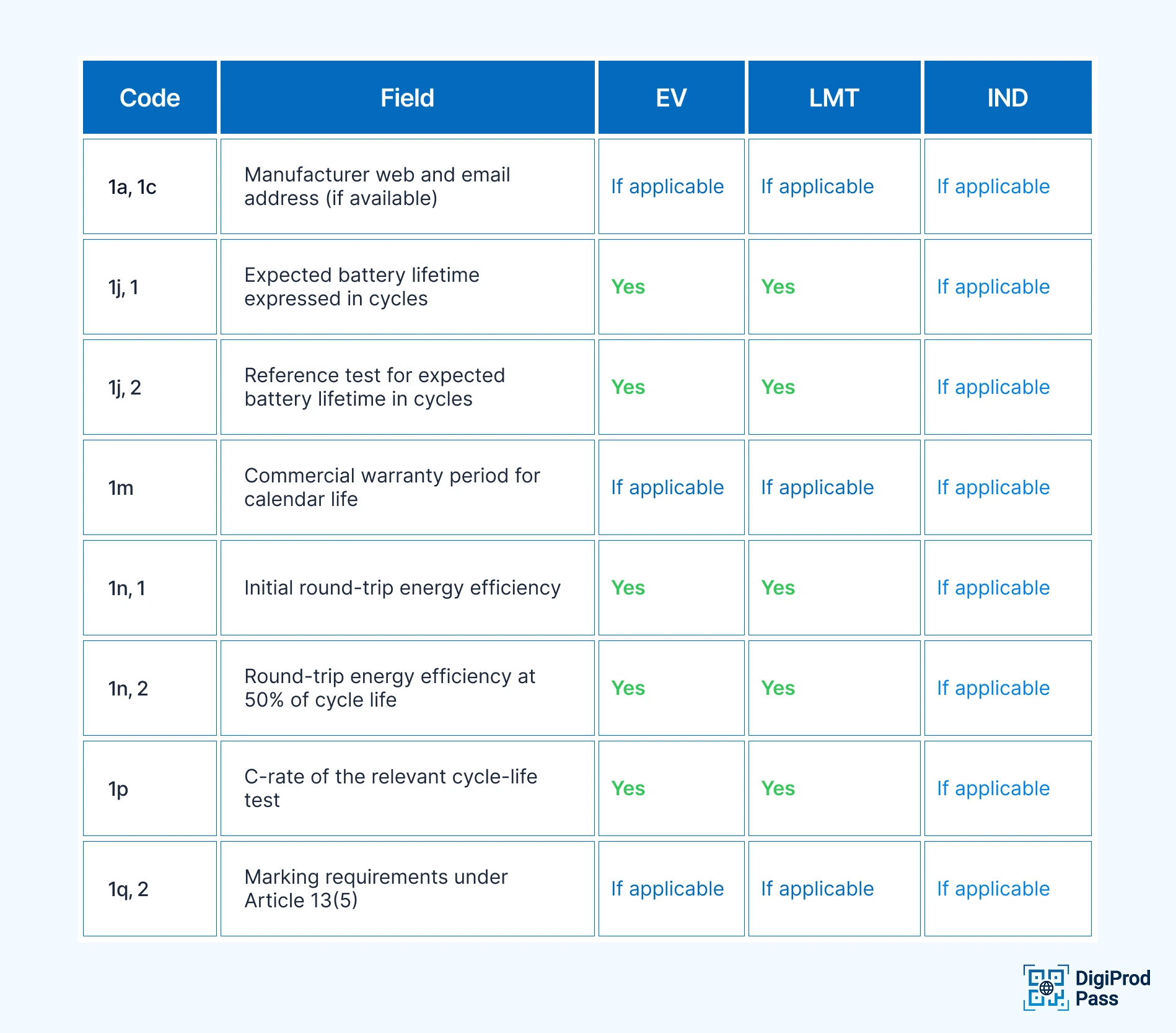
The passport has many fields. Article 77(2) says you only fill in the ones that already apply to your specific battery. The content of the passport is defined in Annex XIII, the section of the Batteries Regulation listing exactly what goes in the passport, and cannot be further specified by the Commission. The Commission can only amend Annex XIII based on scientific and technical progress.
Data requirements — not applicable by battery type
Source: July 7 webinar — Laurent Schoonjans, European Commission. Codes refer to Annex XIII of Regulation (EU) 2023/1542.
.webp)
DigiProd Pass is active through autoMatPass — an EIT RawMaterials-supported EU project building a Consolidated Digital Product Passport for the full powertrain system of a Fiat 500e BEV, covering critical raw material traceability from sub-component to complete powertrain — and EcoPlast, a Horizon Europe project building digital circular solutions for traceable automotive plastics across nine real-world industrial use cases. It also participates in BASE, a Horizon Europe project building an interoperable Digital Battery Passport framework across automotive, marine, and stationary battery use cases, validating traceability, circularity, and ESG indicators ahead of the EU's February 2027 mandate.
DigiProd Pass is Catena-X certified and ISO 27001 certified, aligning its data exchange approach with the same automotive network standard referenced throughout this article and confirming its information security management meets recognised international requirements.
Battery sector partners, including Corvus Energy, WATT EV, Instagrid and Cleantron, are already working with DigiProd Pass on battery passport pilots. The platform integrates with ERP, PLM and SCM systems, collects and manages data for new requirements, maintains audit readiness across product lines, and stays aligned with current and future EU regulations without rework.
Ready to turn these EC confirmations into a compliant battery passport? DigiProd Pass is already supporting manufacturers, importers and compliance teams building toward February 2027.
Book a demo at digiprodpass.com/battery-passport
Does every battery passport field in Annex XIII need to be filled in?
No. You only include fields that apply to your specific battery. If your battery has no BMS, the state of health field stays empty. If it contains no Annex X materials, due diligence stays empty. Non-rechargeable batteries are outside the scope of Articles 7 and 10 entirely.
Who is legally responsible for the battery passport?
The economic operator placing the battery on the EU market — normally the EU manufacturer or importer. For direct sales from outside the EU to the end-user, the operator offering the product for sale is also responsible. Written authorisation can be given to a service provider, manufacturer when importing, cell manufacturer, or OEM. When a battery is remanufactured or significantly transformed, a new passport is required, and a new operator assumes responsibility.
When does the due diligence report need to appear in the battery passport?
By August 2028. That is when the verified report under Article 52(3) must be linked to and accessible through the passport. The obligation to conduct due diligence runs separately.
Sources
1. European Commission DG GROW — Roundtable on Batteries' Digital Product Passport, Brussels, 13 April 2026.
2. European Commission DG GROW — Webinar: The Digital Product Passport — Implications and Practical Guidance for the Battery Industry, 27 May 2026.
3. European Commission DG GROW — Webinar 2: The EU Digital Product Passport for Batteries — Latest Updates, Key Requirements and Industry Perspectives, 7 July 2026.
4. Regulation (EU) 2023/1542 of the European Parliament and of the Council of 12 July 2023 on batteries and waste batteries.
5. KPMG European Digital Product Passport Readiness Survey, February 2026.
6. EUR-Lex — https://eur-lex.europa.eu/eli/reg/2023/1542/oj/eng
7. EUR-Lex consolidated — https://eur-lex.europa.eu/legal-content/EN/TXT/HTML/?uri=CELEX:02023R1542-20250731
.svg)

.svg)

%202026_1310.webp)

.svg)
.svg)